
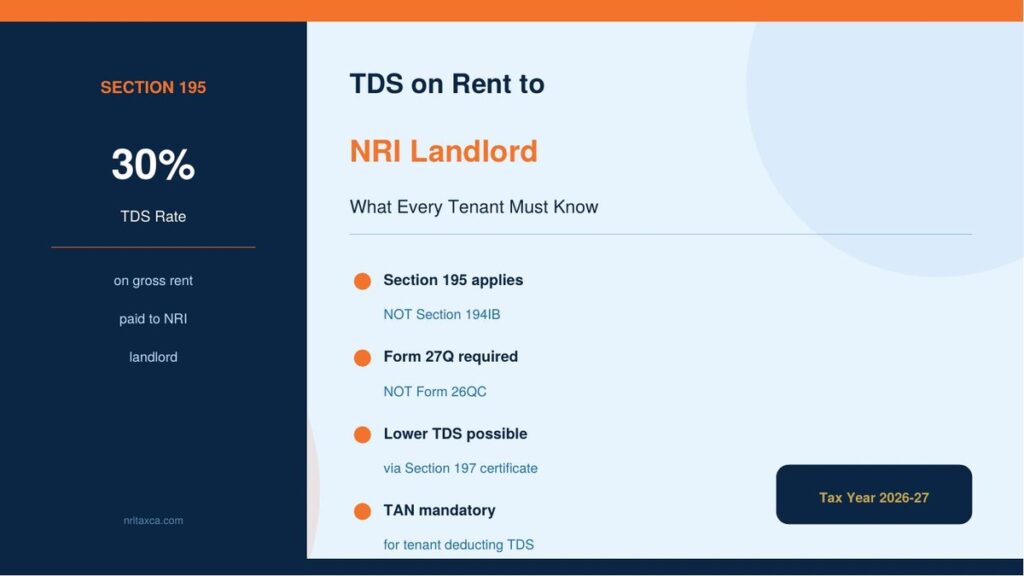
If you are a resident Indian paying rent to an NRI landlord, you have a legal obligation to deduct TDS before making each payment. Many tenants are unaware of this requirement — and the consequences of missing it fall entirely on the tenant, not the landlord.
Under the Income Tax Act 2025 effective from 1 April 2026, the concept of Assessment Year is replaced by Tax Year which aligns directly with the financial year. Tax Year 2026-27 begins on 1 April 2026.
This guide is written for the tenant — the person legally responsible for deducting TDS before paying rent. If you are the NRI landlord receiving the rent and want to understand how to declare it, claim DTAA relief, or file your own Indian tax return, see our companion guide, NRI Rental Income Tax India 2026 — TDS, ITR & DTAA Guide.
Which Section Applies — 195 or 194IB?
This is the most common confusion. Section 194IB applies when a resident tenant pays rent exceeding ₹50,000 per month to a resident landlord.
When the landlord is an NRI, Section 195 applies — regardless of the rent amount. The rules under Section 195 are significantly stricter and the TDS rate is much higher.
TDS Rate on Rent Paid to NRI Landlord
Under Section 195 the TDS rate on rent paid to an NRI landlord is 30% on the gross rent amount plus applicable surcharge and cess.
This compares with just 1% TDS when paying rent to a resident Indian under Section 194IA.
However the NRI landlord can apply for a Lower TDS Certificate under Section 197. If granted, you deduct at the lower rate specified in that certificate. Always ask your NRI landlord whether they hold one before making the first payment.
Step by Step — How to Deduct and Deposit TDS
Step 1 — Obtain TAN As the tenant you must have a Tax Deduction Account Number. Apply online at tin.nsdl.com using Form 49B.
Step 2 — Deduct TDS from each payment Before transferring rent deduct the applicable TDS amount from each payment.
Step 3 — Deposit TDS by 7th of following month Deposit using Challan 281 online through the Income Tax portal. Due date is the 7th of the month following the month of deduction.
Step 4 — File TDS Return in Form 27Q For payments to non-residents including NRI landlords file quarterly TDS returns in Form 27Q — not Form 26Q which is for resident payees. This is a critical distinction most tenants miss.
Step 5 — Issue Form 16A to the landlord After filing the quarterly return download Form 16A from TRACES and provide it to your NRI landlord. They use this when filing their Indian tax return.
Form 26QC — Does It Apply Here?
No. Form 26QC is exclusively for Section 194IB — resident tenant paying rent to resident landlord exceeding ₹50,000 per month.
When the landlord is an NRI, Section 195 and Form 27Q apply. Filing 26QC instead of 27Q is one of the most common compliance errors — it creates problems for both tenant and landlord.
Consequences of Not Deducting TDS
- Interest at 1% per month from date TDS was deductible to date of actual deduction
- Interest at 1.5% per month from date of deduction to date of deposit
- Penalty equal to TDS amount under Section 271C
- Rent payments may be disallowed as expense in your tax return
- In serious cases prosecution under Section 276B
All consequences fall on the tenant — not the NRI landlord.
From the NRI Landlord’s Perspective
TDS deducted appears in Form 26AS against the landlord’s PAN. The landlord claims it as tax credit when filing their Indian tax return and can apply for a refund if TDS exceeds actual tax liability.
The NRI landlord must also file an Indian tax return declaring the rental income regardless of TDS deducted at source.
Common Questions
My NRI landlord says TDS is not required — is this correct? No. TDS deduction is the tenant’s legal obligation. The only exception is a valid NIL deduction certificate from the Income Tax Department held by the landlord.
I already paid rent without deducting TDS — what now? Deduct the shortfall from the next payment and deposit total pending TDS immediately with applicable interest.
PAN of NRI landlord not available — what rate applies? Without valid PAN, TDS must be deducted at the higher of 30% or 20% — effectively making PAN collection mandatory before first payment.
Need Help?
Our team handles TDS compliance for tenants paying rent to NRI landlords and for NRI landlords receiving Indian rental income. We advise on correct rates, Form 27Q filing, Lower TDS Certificate applications, and Indian tax return filing.
Email us at hello@nritaxca.com or visit nritaxca.com.
Use our NRI tax calculator to estimate TDS on rent payable to your NRI landlord. For Lower TDS Certificate applications or compliance, contact our NRI tax team.
Get It Right the First Time — Submit your case and our ICAI-registered CA team will handle TAN registration, TDS computation, Form 27Q filing, and Lower TDS Certificate applications for you, priced under our standard ITR and advisory packages. You receive a written, fixed quote within 2 hours — no phone calls, no surprise fees.
Submit Your TDS Case for a Fixed Quote →
Leave a Reply