πŸ“… ITR Filing Deadline: July 31, 2026 β€” 75 days remaining for FY 2025-26 Β |Β  Secure your CA slot β†’
πŸ“… ITR Filing Deadline: July 31, 2026 for FY 2025-26. Secure your CA slot β†’ hello@nritaxca.com

Tag: capital gains

  • TDS on NRI Property Sale in India 2026 β€” Complete Guide for Buyers and Sellers

    When an NRI sells property in India, the tax and TDS rules are significantly different from those applicable to resident Indians. Both the NRI seller and the Indian buyer have specific obligations under the Income Tax Act 2025. Getting these wrong can result in massive over-deduction of TDS, blocked funds, or penalties on the buyer. This guide explains everything clearly.

    Who Must Deduct TDS β€” The Buyer’s Obligation

    When a resident Indian buys property from an NRI, the buyer is legally required to deduct TDS at source under Section 195 of the Income Tax Act. This is not optional. The buyer must deduct TDS before making payment to the NRI seller and deposit it to the government. Failure to do so makes the buyer a defaulter β€” attracting interest, penalty, and even prosecution.

    The standard TDS rate on NRI property sale is 20% on long-term capital gains (property held over 2 years) and 30% on short-term capital gains. Crucially, these rates apply on the full sale consideration, not just the profit β€” unless the NRI obtains a Lower TDS Certificate.

    The Lower TDS Certificate β€” Form 128 (Erstwhile Form 13)

    The biggest financial mistake NRI sellers make is not applying for a Lower TDS Certificate (now Form 128 under the Income Tax Act 2025, previously Form 13 under the old Act). Without this certificate, the buyer deducts 20–22% TDS on the entire sale value β€” say β‚Ή1 crore on a β‚Ή5 crore property β€” even if the actual taxable gain after exemptions is only β‚Ή30 lakhs.

    With a Lower TDS Certificate, the Income Tax Officer determines the exact taxable gain after accounting for indexed cost of acquisition, improvement costs, and exemptions under Section 54/54EC. TDS is then deducted only on the actual taxable amount β€” potentially reducing TDS from β‚Ή1 crore to β‚Ή6 lakhs in the above example.

    At NRI Tax CA, we handle Form 128 applications starting at β‚Ή7,999. The process involves computing capital gains, preparing the application, liaising with the Income Tax Officer, and obtaining the certificate β€” typically within 2–4 weeks of filing.

    Form 144 β€” TDS Return Filing by the Buyer (Erstwhile Form 27Q)

    After deducting TDS, the buyer must file a quarterly TDS return in Form 144 (renamed from Form 27Q under the Income Tax Act 2025). This return reports the TDS deducted on payments to non-residents. The buyer must also issue a TDS certificate (Form 16A) to the NRI seller, which the seller uses to claim TDS credit when filing their ITR.

    Due dates for Form 144 filing are quarterly β€” 31 July, 31 October, 31 January, and 31 May. Late filing attracts a penalty of β‚Ή200 per day. At NRI Tax CA, we handle complete Form 144 filing for buyers at β‚Ή3,999 per transaction.

    Capital Gains Tax Computation for NRI Sellers

    NRI sellers are taxed on capital gains from Indian property under the same rules as residents, but with additional DTAA considerations. Key points:

    • Long-term capital gains (property held 24+ months): Taxed at 12.5% without indexation from FY 2024-25 onwards, or 20% with indexation for properties acquired before 23 July 2024 (taxpayer’s choice).
    • Short-term capital gains (held less than 24 months): Taxed at applicable income tax slab rates.
    • DTAA benefit: NRIs residing in countries with DTAA (USA, UK, UAE, Canada, Australia, etc.) may be entitled to preferential tax treatment or credit for taxes paid in the country of residence.
    • Section 54 exemption: Long-term capital gains reinvested in another residential property within specified timelines are exempt.
    • Section 54EC exemption: Gains up to β‚Ή50 lakhs invested in NHAI/REC bonds within 6 months are exempt.

    Repatriation After Property Sale

    After the sale and TDS payment, the NRI seller can repatriate the net proceeds abroad subject to RBI guidelines. Repatriation from NRO account is permitted up to USD 1 million per financial year for NRIs, after payment of applicable taxes. You will need Form 145 and Form 146 (erstwhile 15CA/15CB) for the bank to process the overseas transfer.

    Step-by-Step Timeline for NRI Property Sale

    1. Pre-sale: NRI seller applies for Lower TDS Certificate (Form 128) β€” takes 2–4 weeks.
    2. At sale: Buyer deducts reduced TDS as per certificate. Sale deed registered.
    3. Within 30 days: Buyer deposits TDS to government via challan.
    4. Within the quarter: Buyer files Form 144 (erstwhile 27Q) and issues Form 16A to seller.
    5. ITR filing: NRI seller files ITR, claims TDS credit, and claims applicable exemptions.
    6. Repatriation: With tax clearance and Form 145/146, seller repatriates funds.

    Get Expert Help

    NRI property transactions involve multiple interdependent compliance steps. A mistake by the buyer or seller can result in penalties, blocked accounts, or excess tax deduction that takes years to refund. At NRI Tax CA, we handle the entire chain β€” Form 128 application, Form 144 filing, ITR, and repatriation documentation β€” so your transaction is fully protected.

    Compute TDS on your NRI property sale accurately with our free NRI tax calculator. For Form 15CA/15CB filing and Lower TDS Certificate application, get CA assistance here.

    Submit your case here and receive a complete fixed-fee quote within 2 hours.

  • NRI Selling Property in India β€” Complete Tax Guide 2026

    πŸ“… Planning to sell Indian property? ITR deadline is July 31, 2026. Get CA help now β†’

    NRI Selling Property in India β€” Complete Tax Guide 2026

    Selling property in India as an NRI involves two tax systems, mandatory TDS on the entire sale value, strict FEMA repatriation rules, and a bank that won’t process your transfer without CA-certified documents. This guide covers the complete process for FY 2025-26.

    The Biggest Problem β€” TDS on Full Sale Value, Not Just the Gain

    Under Section 195, the buyer deducts TDS on the entire sale consideration β€” not just the profit. On a β‚Ή1 crore property with actual gain of β‚Ή35 lakh, TDS deducted is β‚Ή12.5 lakh+ while actual tax is β‚Ή4.4 lakh. The β‚Ή8+ lakh difference sits with the Income Tax Department for 12-18 months.

    Gain TypeHolding PeriodTDS Rate
    Long TermMore than 24 months12.5% + surcharge + cess
    Short Term24 months or less30% + surcharge + cess

    The Solution β€” Lower TDS Certificate (Section 197)

    Apply via Form 13 on the Income Tax portal at least 8-10 weeks before the sale. The Assessing Officer then specifies a TDS rate matching your actual liability. This is the single most important step for any NRI property sale above β‚Ή50 lakh.

    Capital Gains Exemptions Available to NRIs

    SectionHow to ClaimDeadline
    Section 54Reinvest capital gains in new residential property2 yrs (buy) / 3 yrs (construct)
    Section 54ECInvest up to β‚Ή50L in NHAI/REC bonds6 months from sale date
    Section 54FSelling non-residential asset, reinvest full consideration2 yrs (buy) / 3 yrs (construct)

    Warning: Section 54EC’s 6-month window runs from sale date, not refund date. Invest in bonds first, file ITR later.

    Repatriation β€” Form 145 and Form 146 (Replaces 15CA/15CB)

    From April 1, 2026, Form 15CA is replaced by Form 145 and Form 15CB by Form 146. Submit these to your bank to transfer sale proceeds abroad. Repatriation limit: USD 1 million per financial year.

    5 Most Expensive Mistakes

    1. Not applying Form 13 in time β€” β‚Ή8-15 lakh stuck for 18 months.
    2. Missing 54EC 6-month bond deadline β€” full tax applies.
    3. Not filing ITR β€” TDS refund permanently lost.
    4. Using old Form 15CA/15CB after April 2026 β€” bank rejects transfer.
    5. No improvement cost receipts β€” legitimate deductions lost.

    Our Fees

    ServicePrice
    ITR-2 with capital gains + Section 54/54ECStarting β‚Ή4,999
    Form 145 + 146 for repatriationStarting β‚Ή3,999
    Complete property sale packageStarting β‚Ή6,999

    Planning a sale? Start Form 13 now β€” waiting costs lakhs.
    Email hello@nritaxca.com β€” quote in 2 hours.
    Start Your Case β†’

    Use our NRI property sale tax calculator to compute capital gains, TDS and net repatriation. For Lower TDS Certificate or Form 15CA/15CB filing, contact our NRI tax team.

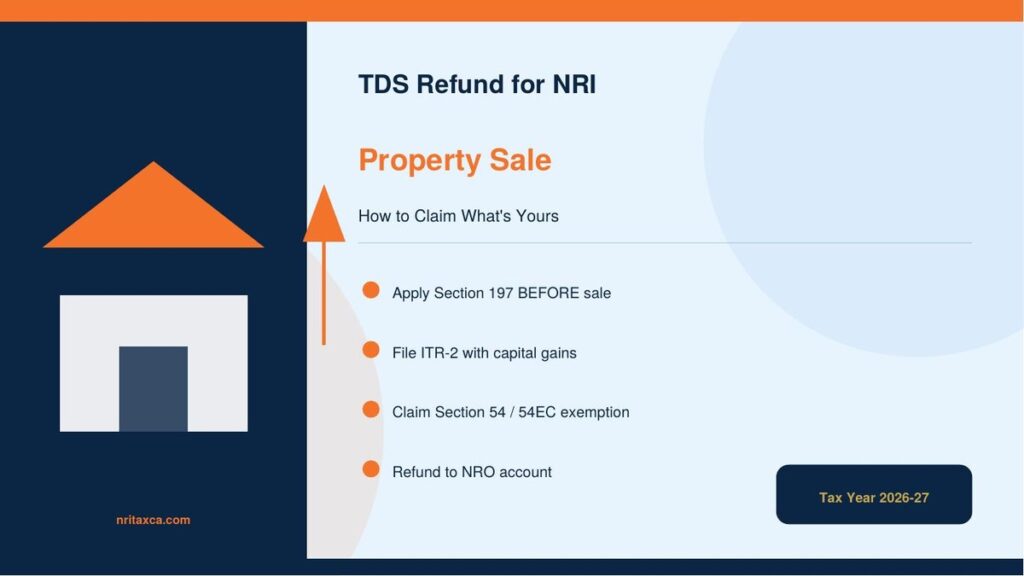
  • TDS Refund for NRI on Property Sale in India β€” How to Claim It (Tax Year 2026-27)

    When an NRI sells property in India, the buyer is legally required to deduct TDS on the sale proceeds. The problem is that TDS is deducted on the entire sale value β€” not just the actual profit. This means most NRIs end up with far more tax deducted than their actual liability.

    The good news is that this excess TDS is fully refundable. But the process requires correct steps in the right order.


    Why TDS Is Deducted in Excess on NRI Property Sales

    Under Section 195 of the Income Tax Act, when a buyer purchases property from an NRI seller, TDS must be deducted at:

    • 12.5% on the entire sale consideration for long term capital gains (property held more than 2 years)
    • 30% on the entire sale consideration for short term capital gains (property held 2 years or less)

    The critical word is entire sale consideration β€” not just the gain.

    For example if an NRI sells a property for β‚Ή60 lakh that was purchased for β‚Ή24 lakh, the actual long term capital gain is β‚Ή36 lakh and the tax liability is approximately β‚Ή4.5 lakh. But TDS is deducted at 12.5% on the full β‚Ή60 lakh β€” which equals β‚Ή7.5 lakh plus surcharge and cess, often totalling β‚Ή8.5 lakh or more.

    The excess of approximately β‚Ή4 lakh is stuck with the Income Tax Department until you claim it back.


    Option 1 β€” Apply for Lower TDS Certificate Before the Sale

    This is the smartest approach β€” done before the sale happens.

    Under Section 197 an NRI seller can apply to the Assessing Officer for a Lower or NIL TDS Certificate before the sale is executed. The application is filed in Form 13 on the Income Tax portal.

    The Assessing Officer reviews the actual capital gains calculation and issues a certificate specifying a lower TDS rate matching the real tax liability. The buyer then deducts at this lower rate instead of the standard rate.

    This prevents the cash flow problem entirely β€” you never lose the excess amount in the first place.

    Important: Apply at least 2 to 3 months before the sale. The process takes time and the certificate must be in hand before the sale agreement is executed.


    Option 2 β€” Claim Refund Through ITR Filing After the Sale

    If TDS was already deducted at the higher rate without a Lower TDS Certificate, the refund comes through filing your Indian Income Tax Return.

    Step 1 β€” Verify TDS in Form 26AS Log into the Income Tax portal and check Form 26AS or AIS. The TDS deducted by the buyer should reflect against your PAN. Confirm the amount before proceeding.

    Step 2 β€” Compute actual capital gains Calculate your actual capital gains correctly β€” purchase price, improvement costs, indexation if applicable for pre July 2024 purchases, and applicable exemptions.

    Step 3 β€” Check exemptions available

    Before filing consider whether you qualify for:

    • Section 54 β€” invest capital gains in another residential property within 2 years of sale or 3 years if constructing
    • Section 54EC β€” invest capital gains up to β‚Ή50 lakh in NHAI or REC bonds within 6 months of sale
    • Section 54F β€” for sale of assets other than residential property

    Claiming these exemptions can reduce your actual tax liability to zero β€” making the entire TDS deducted refundable.

    Step 4 β€” File ITR-2 File your Indian Income Tax Return in ITR-2 declaring the property sale, capital gains, exemptions claimed, and TDS deducted. The refund amount is automatically calculated.

    Step 5 β€” Verify the return and await refund After e-filing, verify the return using Aadhaar OTP or net banking. The Income Tax Department processes refunds typically within 3 to 6 months of filing though delays of up to 18 months are common for NRI cases with large refund amounts.


    Can the Refund Go to a Foreign Bank Account?

    Yes β€” but with conditions. The refund is credited to the bank account linked to your PAN on the Income Tax portal. You can link an NRO account for this purpose. Refunds cannot be credited directly to foreign bank accounts outside India.

    Once the refund reaches your NRO account you can then repatriate it to your foreign account subject to the standard Form 15CA/15CB and USD 1 million per financial year repatriation limits.


    What About Form 15CA and 15CB for Repatriation of Sale Proceeds?

    These are separate from the refund process. Before your bank transfers the property sale proceeds from your NRO account to your foreign account you must submit Form 15CA and a CA-certified Form 15CB. These confirm that applicable taxes have been paid on the remittance.

    The refund amount once credited to your NRO account also requires Form 15CA/15CB for repatriation.


    Timeline β€” What to Expect

    If you apply for Lower TDS Certificate before sale β€” TDS deducted matches actual liability. Minimal or no refund needed.

    If claiming refund after sale through ITR β€” file ITR by 31 July of the Tax Year following the sale. Refund typically processed within 3 to 6 months of filing. For large refunds or cases with scrutiny, expect 12 to 18 months.


    Common Mistakes That Delay Refunds

    • PAN not linked with Aadhaar β€” refund gets stuck
    • Wrong bank account details on portal β€” refund rejected
    • ITR not verified within 30 days of filing β€” return treated as invalid
    • Capital gains not reported correctly β€” triggers notice instead of refund
    • Section 54/54EC exemption not claimed despite eligibility β€” excess tax paid

    Need Help Claiming Your TDS Refund?

    Our team handles the complete process for NRI property sale tax compliance β€” Lower TDS Certificate applications, capital gains computation, ITR-2 filing with exemption claims, and Form 15CA/15CB for repatriation.

    Email us at hello@nritaxca.com or visit nritaxca.com.

    Estimate your TDS refund amount using our free NRI property tax calculator. Ready to file your refund claim? Get expert CA assistance from Bilash Paul & Associates, Hisar.


    Use our free NRI Tax Calculator to instantly estimate your property TDS, refund amount and ITR obligation β†’ Calculate Now

  • DTAA for NRIs 2026 β€” Avoid Double Tax on Indian Income | Guide

    βœ… This guide is updated for the Income Tax Act 2025. DTAA benefits apply under the new provisions effective April 1, 2026.

    DTAA for NRIs β€” How to Avoid Double Taxation on Indian Income (2026 Guide)

    If you are an NRI earning income from India β€” rental income, interest on NRO accounts, capital gains from property or shares β€” there is a real risk of paying tax on that same income in both India and your country of residence. The Double Taxation Avoidance Agreement (DTAA) exists to prevent exactly this.

    India has DTAA treaties with over 90 countries. Used correctly, DTAA can reduce your TDS rate from 30% to as low as 10%, eliminate double taxation entirely, and save you lakhs every year. Used incorrectly β€” or not used at all β€” you pay full tax twice.

    This guide explains exactly how DTAA works, which countries have the best treaties with India, how to claim the benefit, and the critical steps most NRIs miss.

    What is DTAA?

    A Double Taxation Avoidance Agreement is a bilateral treaty between India and another country that determines which country has the right to tax specific types of income, and at what rate. When both countries have a right to tax the same income, the treaty specifies how much credit is given in one country for taxes paid in the other.

    For NRIs, DTAA serves two purposes:

    • Reduced TDS rates β€” instead of 30% TDS on NRO interest, you may qualify for 10–15% under DTAA
    • Foreign tax credit β€” taxes paid in India are credited against your tax liability in your country of residence, eliminating double taxation

    How DTAA Works in Practice β€” A Simple Example

    You are an NRI in the UK. Your NRO fixed deposit earns β‚Ή5 lakh interest in FY 2025-26.

    ScenarioWithout DTAAWith DTAA
    TDS deducted in Indiaβ‚Ή1,56,000 (31.2%)β‚Ή75,000 (15% under India-UK DTAA)
    Tax in UK (at 40% rate)β‚Ή2,00,000 minus credit for Indian taxβ‚Ή2,00,000 minus credit for Indian tax
    Total tax paidβ‚Ή2,00,000 (UK taxes globally, credits India TDS)β‚Ή2,00,000 (same total β€” but β‚Ή81,000 saved upfront)
    Cash flow benefitβ‚Ή0 β€” full 31.2% deducted immediatelyβ‚Ή81,000 stays in your account

    DTAA doesn’t always eliminate tax β€” it prevents double tax and reduces upfront TDS deduction, improving your cash flow significantly.

    DTAA Rates by Country β€” Interest Income (NRO Accounts)

    CountryStandard TDSDTAA Rate on InterestAnnual Saving on β‚Ή10L Interest
    πŸ‡¦πŸ‡ͺ UAE31.2%12.5%β‚Ή1,87,000
    πŸ‡ΊπŸ‡Έ USA31.2%15%β‚Ή1,62,000
    πŸ‡¬πŸ‡§ UK31.2%15%β‚Ή1,62,000
    πŸ‡¦πŸ‡Ί Australia31.2%15%β‚Ή1,62,000
    πŸ‡¨πŸ‡¦ Canada31.2%15%β‚Ή1,62,000
    πŸ‡ΈπŸ‡¬ Singapore31.2%15%β‚Ή1,62,000
    πŸ‡³πŸ‡Ώ New Zealand31.2%10%β‚Ή2,12,000
    πŸ‡³πŸ‡± Netherlands31.2%10%β‚Ή2,12,000

    Step-by-Step β€” How to Claim DTAA Benefit

    Step 1 β€” Obtain Tax Residency Certificate (TRC)

    A TRC is a certificate issued by the tax authority of your country of residence confirming that you are a tax resident there. This is the foundational document for any DTAA claim.

    How to get TRC by country:

    • UAE: Apply to the Federal Tax Authority (FTA) online β€” issued within 5 working days
    • UK: Apply to HMRC using form RES1 β€” takes 4–6 weeks
    • USA: Apply to IRS using Form 8802 β€” takes 45–60 days
    • Australia: Apply to ATO β€” Certificate of Residency issued within 28 days
    • Canada: Apply to CRA β€” typically 2–4 weeks

    Apply for your TRC at the start of each financial year (April 1). Many NRIs delay this and miss the benefit for the entire year because their TRC wasn’t ready when TDS was deducted.

    Step 2 β€” File Form 10F Electronically

    Form 10F is a self-declaration filed on the Indian Income Tax portal confirming your residential status and DTAA eligibility. It must be filed electronically on incometax.gov.in β€” paper submissions are no longer accepted.

    Step 3 β€” Submit TRC and Form 10F to Your Bank / Payer

    Provide both documents to your bank (for NRO FD interest), your tenant (for rental income), the company paying dividends, and any other payer of Indian income. The payer will then deduct TDS at the DTAA rate rather than the standard 30% rate.

    Step 4 β€” Claim DTAA Relief in Your ITR-2

    Even after claiming reduced TDS at source, you must declare the DTAA benefit in your Indian ITR-2 in Schedule TR (Tax Relief). This formally records the relief claimed and protects against any future dispute.

    DTAA and Capital Gains β€” What Changes

    CountryCapital Gains on Indian PropertyPractical Impact
    πŸ‡¦πŸ‡ͺ UAETaxable only in IndiaNo UAE tax on Indian property gain. Zero double taxation.
    πŸ‡ΊπŸ‡Έ USAMay be taxable in bothIndia taxes first. USA allows Foreign Tax Credit for Indian tax paid.
    πŸ‡¬πŸ‡§ UKTaxable in India, credit in UKUK gives credit for Indian CGT paid.
    πŸ‡¦πŸ‡Ί AustraliaTaxable in India, credit in AUSAustralia gives foreign tax offset for Indian CGT paid.
    πŸ‡¨πŸ‡¦ CanadaTaxable in India, credit in CANCanada gives Foreign Tax Credit for Indian tax paid.

    The Most Common DTAA Mistakes NRIs Make

    • Not applying for TRC in time β€” TRC takes 4–8 weeks. Apply in March for the new financial year.
    • Not filing Form 10F electronically β€” Paper Form 10F is no longer accepted. Electronic filing on the Income Tax portal is mandatory since 2023.
    • Not claiming DTAA in ITR-2 β€” Even if TDS was deducted at the correct DTAA rate, formally claim the benefit in Schedule TR of your ITR-2.
    • Assuming UAE NRIs pay zero tax in India β€” UAE has no personal income tax, but Indian income is still taxed in India. You need TRC and Form 10F to access the reduced DTAA interest rate of 12.5%.
    • Using an expired TRC β€” TRC is valid for one financial year. Renew every year without fail.
    • Not claiming foreign tax credit in your home country β€” Claim the Foreign Tax Credit in your home country’s return to avoid paying tax twice.

    DTAA and Form 146 (Formerly Form 15CB)

    When you remit money from India using Form 145 and Form 146, the CA issuing Form 146 must certify the applicable DTAA provisions for the remittance. This requires analysis of which DTAA article governs the income, whether the remittance qualifies for relief, the correct tax rate, and whether TRC and Form 10F are in order. A Form 146 that incorrectly applies DTAA provisions can create tax demands later.

    Frequently Asked Questions

    I am an NRI in UAE. Do I pay zero tax in India?

    No. India taxes income sourced from India regardless of where you live. NRO interest, rental income, and capital gains on Indian property are taxable in India. However, UAE imposes no personal tax, so you pay tax only to India β€” no double taxation. The DTAA reduces your TDS rate on interest to 12.5%.

    My bank already deducted TDS at 30%. Can I claim the DTAA benefit now?

    Yes β€” through your ITR-2. Declare the income, claim DTAA relief in Schedule TR, and the excess TDS is refunded. However, you needed TRC and Form 10F before the deduction to get the reduced rate at source.

    Do I need a new TRC every year?

    Yes. TRC is issued for a specific financial year. Submit a fresh TRC to your bank at the start of every financial year (April 1).

    Can I claim DTAA benefit on NRE account interest?

    NRE account interest is fully exempt in India β€” no TDS applies. DTAA relief is not relevant for NRE accounts. It is primarily relevant for NRO account income.

    What if my country doesn’t have a DTAA with India?

    Without a DTAA, India’s domestic tax law (Section 91) provides unilateral relief β€” you can claim credit for foreign taxes paid even without a treaty. A CA should calculate the most beneficial treatment for your situation.

    My CA filed my ITR without claiming DTAA. Can I revise it?

    Yes. A revised ITR can be filed up to December 31, 2026 for FY 2025-26. File a revised return claiming the DTAA benefit in Schedule TR to get the correct tax treatment and any refund due.

    How We Handle DTAA at NRI Tax CA

    Every filing we handle includes DTAA analysis as standard β€” not as an add-on. When we file Form 146 for a remittance, we analyse the applicable treaty article, verify TRC and Form 10F are in order, and certify the correct DTAA rate. When we file ITR-2, we include Schedule TR and Schedule TR-S to formally record all DTAA relief claimed.

    ServicePrice
    Form 145 + 146 with DTAA analysisStarting β‚Ή5,999
    NRI ITR-2 with DTAA + Schedule TRStarting β‚Ή4,999
    DTAA advisory consultationEmail hello@nritaxca.com

    Are you claiming all the DTAA benefits you’re entitled to?
    Email hello@nritaxca.com β€” we’ll review your situation and tell you exactly what’s available.

    Check your DTAA benefit with our free NRI tax calculator β€” it factors in treaty rates automatically. For ITR filing with DTAA claims, consult our NRI tax experts.

    Updated April 2026. Reflects Income Tax Act 2025 provisions. DTAA treaty rates are subject to change β€” verify with your CA before filing.

  • NRI Selling Property in India β€” Complete Guide to TDS, Form 15CA/15CB and Repatriation (2025-26)


    Selling property in India as an NRI involves far more than finding a buyer and signing a sale deed. The tax and compliance requirements β€” if missed β€” can result in penalties, blocked remittances, or notices from the Income Tax Department. This guide covers everything you need to know for AY 2025-26.

    Who Qualifies as an NRI for Property Sale Purposes?

    An individual is treated as an NRI under the Income Tax Act if they spent fewer than 182 days in India during the previous financial year. Residential status determines tax rates, TDS obligations, and repatriation eligibility β€” so confirming your status before the sale is essential.

    TDS on NRI Property Sale β€” The Buyer’s Obligation

    When an NRI sells property, the buyer must deduct TDS before making payment. This is mandatory under Section 195 of the Income Tax Act regardless of the buyer’s own tax status.

    The applicable TDS rates are 20% on long term capital gains (property held more than 2 years) and 30% on short term capital gains (held 2 years or less). Surcharge and cess apply on top of these rates, which means the effective TDS deduction can reach 22-23% or higher depending on the sale value.

    The buyer must deposit this TDS using Form 26QB and issue Form 16B to the seller within 15 days of filing.

    Capital Gains Computation β€” Long Term vs Short Term

    Long term capital gains on property held more than 24 months are computed after applying the Cost Inflation Index (CII) to the original purchase price. This indexed cost is deducted from the sale consideration to arrive at the taxable gain.

    For a property purchased in 2009-10 and sold in 2025-26, the CII benefit significantly reduces the taxable gain β€” often by 40 to 60 percent of the original cost.

    Short term gains (property held under 24 months) are taxed at slab rates without indexation benefit, making timing of the sale an important planning consideration.

    Exemptions Available to NRIs

    Two key exemptions can reduce or eliminate capital gains tax entirely.

    Section 54 allows exemption if the NRI reinvests the capital gains in a new residential property in India within 2 years of sale (or constructs within 3 years). The new property must not be sold within 3 years of purchase.

    Section 54EC allows exemption up to Rs. 50 lakhs if the capital gains amount is invested in specified bonds (NHAI or REC) within 6 months of the sale date. These bonds have a mandatory lock-in of 5 years.

    What is Form 15CA and Form 15CB?

    Form 15CB is a certificate issued by a Chartered Accountant certifying the nature of the remittance, applicable DTAA provisions, TDS computation, and tax liability. It is a mandatory document required by your bank before processing any international remittance.

    Form 15CA is an online declaration filed on the Income Tax portal by the remitter, based on the details certified in the 15CB. Together, these two documents form the compliance backbone of any NRI remittance out of India.

    Without both documents, no Indian bank will transfer funds abroad β€” regardless of how much TDS has already been deducted.

    DTAA β€” How Double Taxation is Avoided

    India has Double Taxation Avoidance Agreements with over 90 countries including the USA, UK, UAE, Australia, Canada, and Singapore. Under these treaties, capital gains may be taxable only in one country β€” either India or the country of residence β€” depending on the treaty provisions.

    For example, under the India-UAE DTAA, capital gains on immovable property are taxable in India. However, since UAE levies no personal income tax, no double taxation arises. Under the India-UK DTAA, the gain is taxable in India but the UK allows a foreign tax credit for taxes paid in India.

    Proper DTAA analysis before the sale can result in significant tax savings and must be done by a qualified CA.

    Repatriation of Sale Proceeds

    NRIs can repatriate up to USD 1 million per financial year from the sale of immovable property, subject to the following conditions. The property must have been acquired in accordance with FEMA regulations. TDS must have been correctly deducted and deposited. Form 15CA and 15CB must be submitted to the bank. The funds must be routed through an NRO account.

    Repatriation beyond USD 1 million in a single year requires prior RBI approval.

    Summary β€” Key Steps for NRI Property Sale

    Confirm your residential status before initiating the sale. Compute capital gains and evaluate Section 54 or 54EC exemptions. Ensure the buyer deducts correct TDS under Section 195. Obtain Form 15CB from a CA and file Form 15CA on the Income Tax portal. Submit both forms to your bank along with the sale deed and other KYC documents. Initiate repatriation through your NRO account within applicable FEMA limits.

    Need Help with Form 15CA/15CB or NRI Tax Advisory?

    Every NRI property sale is different β€” the DTAA provisions, exemption eligibility, and TDS computation depend on your specific facts. At NRI Tax CA, we handle the complete compliance process including capital gains computation, 15CB certification, 15CA filing, and repatriation advisory β€” delivered entirely over email within 24 to 48 hours.

    Email us atΒ hello@nritaxca.comΒ or visit nritaxca.com to get started.

    Use our free NRI tax calculator to estimate TDS, repatriation limits and Form 15CB fees. Need help with the actual paperwork? Submit your details to our NRI tax team at Bilash Paul & Associates, Hisar.

NRI Tax CA
Replies within 2 hours
👋 Hi! Need CA help with NRI tax — Form 145/146, property TDS, ITR or foreign tax credit?

Fixed quote in 2 hours, all handled over WhatsApp & email.
💬 Start WhatsApp Chat