
📅 ITR Filing Deadline: July 31, 2026 — 75 days remaining for FY 2025-26  |  Secure your CA slot →

Tag: NRI tax

  • DTAA for NRIs 2026 — Avoid Double Tax on Indian Income | Guide

    ✅ This guide is updated for the Income Tax Act 2025. DTAA benefits apply under the new provisions effective April 1, 2026.

    DTAA for NRIs — How to Avoid Double Taxation on Indian Income (2026 Guide)

    If you are an NRI earning income from India — rental income, interest on NRO accounts, capital gains from property or shares — there is a real risk of paying tax on that same income in both India and your country of residence. The Double Taxation Avoidance Agreement (DTAA) exists to prevent exactly this.

    India has DTAA treaties with over 90 countries. Used correctly, DTAA can reduce your TDS rate from 30% to as low as 10%, eliminate double taxation entirely, and save you lakhs every year. Used incorrectly — or not used at all — you pay full tax twice.

    This guide explains exactly how DTAA works, which countries have the best treaties with India, how to claim the benefit, and the critical steps most NRIs miss.

    What is DTAA?

    A Double Taxation Avoidance Agreement is a bilateral treaty between India and another country that determines which country has the right to tax specific types of income, and at what rate. When both countries have a right to tax the same income, the treaty specifies how much credit is given in one country for taxes paid in the other.

    For NRIs, DTAA serves two purposes:

    • Reduced TDS rates — instead of 30% TDS on NRO interest, you may qualify for 10–15% under DTAA
    • Foreign tax credit — taxes paid in India are credited against your tax liability in your country of residence, eliminating double taxation

    How DTAA Works in Practice — A Simple Example

    You are an NRI in the UK. Your NRO fixed deposit earns ₹5 lakh interest in FY 2025-26.

    ScenarioWithout DTAAWith DTAA
    TDS deducted in India₹1,56,000 (31.2%)₹75,000 (15% under India-UK DTAA)
    Tax in UK (at 40% rate)₹2,00,000 minus credit for Indian tax₹2,00,000 minus credit for Indian tax
    Total tax paid₹2,00,000 (UK taxes globally, credits India TDS)₹2,00,000 (same total — but ₹81,000 saved upfront)
    Cash flow benefit₹0 — full 31.2% deducted immediately₹81,000 stays in your account

    DTAA doesn’t always eliminate tax — it prevents double tax and reduces upfront TDS deduction, improving your cash flow significantly.

    DTAA Rates by Country — Interest Income (NRO Accounts)

    CountryStandard TDSDTAA Rate on InterestAnnual Saving on ₹10L Interest
    🇦🇪 UAE31.2%12.5%₹1,87,000
    🇺🇸 USA31.2%15%₹1,62,000
    🇬🇧 UK31.2%15%₹1,62,000
    🇦🇺 Australia31.2%15%₹1,62,000
    🇨🇦 Canada31.2%15%₹1,62,000
    🇸🇬 Singapore31.2%15%₹1,62,000
    🇳🇿 New Zealand31.2%10%₹2,12,000
    🇳🇱 Netherlands31.2%10%₹2,12,000

    Step-by-Step — How to Claim DTAA Benefit

    Step 1 — Obtain Tax Residency Certificate (TRC)

    A TRC is a certificate issued by the tax authority of your country of residence confirming that you are a tax resident there. This is the foundational document for any DTAA claim.

    How to get TRC by country:

    • UAE: Apply to the Federal Tax Authority (FTA) online — issued within 5 working days
    • UK: Apply to HMRC using form RES1 — takes 4–6 weeks
    • USA: Apply to IRS using Form 8802 — takes 45–60 days
    • Australia: Apply to ATO — Certificate of Residency issued within 28 days
    • Canada: Apply to CRA — typically 2–4 weeks

    Apply for your TRC at the start of each financial year (April 1). Many NRIs delay this and miss the benefit for the entire year because their TRC wasn’t ready when TDS was deducted.

    Step 2 — File Form 10F Electronically

    Form 10F is a self-declaration filed on the Indian Income Tax portal confirming your residential status and DTAA eligibility. It must be filed electronically on incometax.gov.in — paper submissions are no longer accepted.

    Step 3 — Submit TRC and Form 10F to Your Bank / Payer

    Provide both documents to your bank (for NRO FD interest), your tenant (for rental income), the company paying dividends, and any other payer of Indian income. The payer will then deduct TDS at the DTAA rate rather than the standard 30% rate.

    Step 4 — Claim DTAA Relief in Your ITR-2

    Even after claiming reduced TDS at source, you must declare the DTAA benefit in your Indian ITR-2 in Schedule TR (Tax Relief). This formally records the relief claimed and protects against any future dispute.

    DTAA and Capital Gains — What Changes

    CountryCapital Gains on Indian PropertyPractical Impact
    🇦🇪 UAETaxable only in IndiaNo UAE tax on Indian property gain. Zero double taxation.
    🇺🇸 USAMay be taxable in bothIndia taxes first. USA allows Foreign Tax Credit for Indian tax paid.
    🇬🇧 UKTaxable in India, credit in UKUK gives credit for Indian CGT paid.
    🇦🇺 AustraliaTaxable in India, credit in AUSAustralia gives foreign tax offset for Indian CGT paid.
    🇨🇦 CanadaTaxable in India, credit in CANCanada gives Foreign Tax Credit for Indian tax paid.

    The Most Common DTAA Mistakes NRIs Make

    • Not applying for TRC in time — TRC takes 4–8 weeks. Apply in March for the new financial year.
    • Not filing Form 10F electronically — Paper Form 10F is no longer accepted. Electronic filing on the Income Tax portal is mandatory since 2023.
    • Not claiming DTAA in ITR-2 — Even if TDS was deducted at the correct DTAA rate, formally claim the benefit in Schedule TR of your ITR-2.
    • Assuming UAE NRIs pay zero tax in India — UAE has no personal income tax, but Indian income is still taxed in India. You need TRC and Form 10F to access the reduced DTAA interest rate of 12.5%.
    • Using an expired TRC — TRC is valid for one financial year. Renew every year without fail.
    • Not claiming foreign tax credit in your home country — Claim the Foreign Tax Credit in your home country’s return to avoid paying tax twice.

    DTAA and Form 146 (Formerly Form 15CB)

    When you remit money from India using Form 145 and Form 146, the CA issuing Form 146 must certify the applicable DTAA provisions for the remittance. This requires analysis of which DTAA article governs the income, whether the remittance qualifies for relief, the correct tax rate, and whether TRC and Form 10F are in order. A Form 146 that incorrectly applies DTAA provisions can create tax demands later.

    Frequently Asked Questions

    I am an NRI in UAE. Do I pay zero tax in India?

    No. India taxes income sourced from India regardless of where you live. NRO interest, rental income, and capital gains on Indian property are taxable in India. However, UAE imposes no personal tax, so you pay tax only to India — no double taxation. The DTAA reduces your TDS rate on interest to 12.5%.

    My bank already deducted TDS at 30%. Can I claim the DTAA benefit now?

    Yes — through your ITR-2. Declare the income, claim DTAA relief in Schedule TR, and the excess TDS is refunded. However, you needed TRC and Form 10F before the deduction to get the reduced rate at source.

    Do I need a new TRC every year?

    Yes. TRC is issued for a specific financial year. Submit a fresh TRC to your bank at the start of every financial year (April 1).

    Can I claim DTAA benefit on NRE account interest?

    NRE account interest is fully exempt in India — no TDS applies. DTAA relief is not relevant for NRE accounts. It is primarily relevant for NRO account income.

    What if my country doesn’t have a DTAA with India?

    Without a DTAA, India’s domestic tax law (Section 91) provides unilateral relief — you can claim credit for foreign taxes paid even without a treaty. A CA should calculate the most beneficial treatment for your situation.

    My CA filed my ITR without claiming DTAA. Can I revise it?

    Yes. A revised ITR can be filed up to December 31, 2026 for FY 2025-26. File a revised return claiming the DTAA benefit in Schedule TR to get the correct tax treatment and any refund due.

    How We Handle DTAA at NRI Tax CA

    Every filing we handle includes DTAA analysis as standard — not as an add-on. When we file Form 146 for a remittance, we analyse the applicable treaty article, verify TRC and Form 10F are in order, and certify the correct DTAA rate. When we file ITR-2, we include Schedule TR and Schedule TR-S to formally record all DTAA relief claimed.

    ServicePrice
    Form 145 + 146 with DTAA analysisStarting ₹5,999
    NRI ITR-2 with DTAA + Schedule TRStarting ₹4,999
    DTAA advisory consultationEmail hello@nritaxca.com

    Are you claiming all the DTAA benefits you’re entitled to?
    Email hello@nritaxca.com — we’ll review your situation and tell you exactly what’s available.

    Check your DTAA benefit with our free NRI tax calculator — it factors in treaty rates automatically. For ITR filing with DTAA claims, consult our NRI tax experts.

    Updated April 2026. Reflects Income Tax Act 2025 provisions. DTAA treaty rates are subject to change — verify with your CA before filing.
  • NRI ITR-2 Filing Guide 2026 — How to File Income Tax in India

    📅 Filing for FY 2025-26 (AY 2026-27)? Check the applicable due date and your original, belated or revised filing route before submitting. Secure your CA slot →

    NRI ITR-2 Filing Guide 2026 — Complete Step-by-Step for FY 2025-26

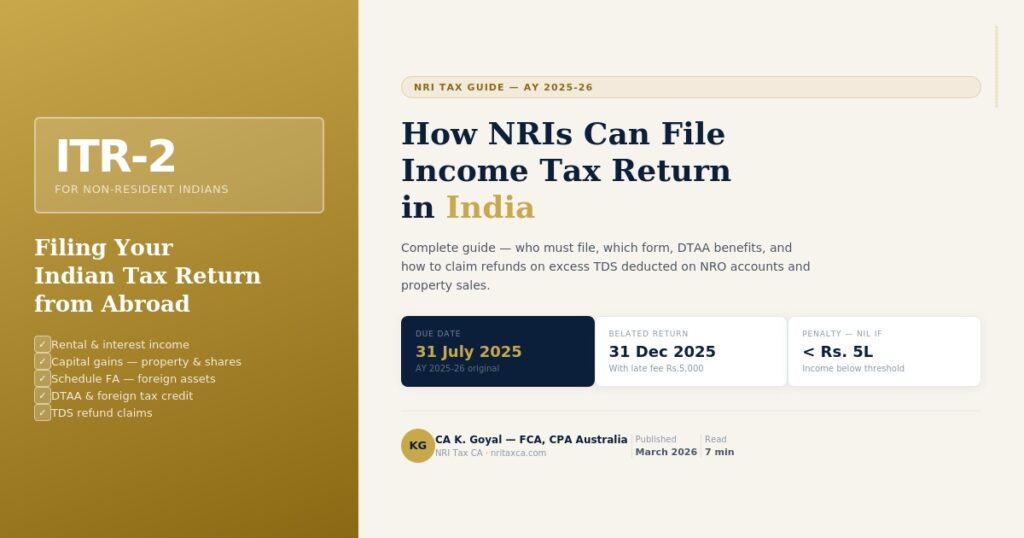
    If you are a Non-Resident Indian (NRI) with income from India — rental income, interest on NRO accounts, capital gains from property or shares, or any other Indian source — you are required to file an Income Tax Return in India for FY 2025-26 (Assessment Year 2026-27). The deadline is July 31, 2026.

    This guide covers overall NRI ITR-2 filing across all income types. If your only Indian income is rental income and you want a guide focused specifically on TDS, DTAA, and repatriation for rental property, see our companion guide, NRI Rental Income Tax India 2026 — TDS, ITR & DTAA Guide.

    This guide covers everything you need to know — which ITR form to use, what income to declare, how to claim DTAA benefits, and how to avoid the most common mistakes NRIs make when filing.


    Who Must File ITR as an NRI in 2026?

    As an NRI, you must file an Indian Income Tax Return if any of the following apply:

    • Your total income from Indian sources exceeds ₹2.5 lakh (old regime) or ₹4 lakh (new regime) in FY 2025-26
    • You have capital gains from sale of property or shares in India — regardless of amount
    • TDS has been deducted on your Indian income and you want to claim a refund
    • You have income from a business or profession in India
    • If you are resident and ordinarily resident, foreign assets may create separate reporting obligations; this is not a Schedule FA trigger for a non-resident
    • You want to carry forward capital losses to offset against future gains

    Even if your Indian income is below the exemption limit, filing an ITR is the only way to claim a refund of TDS that has been deducted at source — for example, 30% TDS on NRO account interest.


    Which ITR Form Do NRIs Use?

    ITR Form When to Use NRI Applicable?
    ITR-1 (Sahaj) Salary + one house property + other income NO — NRIs cannot use ITR-1
    ITR-2 Salary, house property, capital gains, foreign income/assets YES — Most NRIs use this
    ITR-3 Business or professional income in India YES — if NRI has Indian business income
    ITR-4 (Sugam) Presumptive income from business NO — NRIs cannot use ITR-4

    The answer for most NRIs is ITR-2. Use ITR-3 only if you run a business or practice in India. Never use ITR-1 or ITR-4 as an NRI — your return will be defective.


    What Income Do NRIs Declare in ITR-2?

    Taxable Indian Income for NRIs

    Income Type Taxability TDS Rate
    NRO account interest Fully taxable at slab rates 30% + surcharge + cess
    NRE account interest Fully EXEMPT No TDS
    FCNR account interest Fully EXEMPT No TDS
    Rental income from Indian property Taxable after 30% standard deduction 30% by tenant (Section 195)
    Long term capital gains — property 12.5% for relevant transfers on or after 23 July 2024; no indexation for non-residents, subject to applicable exemptions 12.5% on sale value
    Short term capital gains — property Taxable at slab rates 30% on sale value
    Long term capital gains — listed shares 12.5% above ₹1.25 lakh Broker deducts
    Short term capital gains — listed shares 20% (STT paid transactions) Broker deducts
    Dividends from Indian companies Taxable at slab rates 20% TDS
    Foreign salary / income NOT taxable in India for NRIs No TDS

    How to Determine Your Residential Status for FY 2025-26

    For FY 2025-26, determine residence under section 6 of the Income-tax Act, 1961. Fewer than 182 days in India does not automatically establish non-residence: the 60-day plus 365-day test, citizenship/visit exceptions and deemed-residence rules may also matter.

    Deemed residence for an Indian citizen with income above ₹15 lakh, excluding income from foreign sources, depends on not being liable to tax elsewhere by reason of residence, domicile or a similar criterion. It does not follow simply from paying no tax in a particular country.

    Three Residential Categories

    Status Condition What is taxable in India
    NRI Does not meet the applicable resident or deemed-resident tests Only Indian-source income
    RNOR Resident who satisfies an RNOR condition under section 6 Indian income + certain foreign income
    Resident (ROR) Resident who does not qualify as RNOR Global income — including foreign salary

    Important: Count your days carefully using passport stamps and airline records. Even a small error can change your tax status and significantly increase your tax liability.


    Step-by-Step — How to File ITR-2 as an NRI for FY 2025-26

    Step 1 — Gather All Required Documents

    • PAN card
    • PAN and appropriate portal verification details; PAN–Aadhaar linkage is not compulsory for an individual who qualifies as non-resident under the notified exemption
    • Form 26AS / AIS / TIS from the Income Tax portal — shows all TDS deducted against your PAN
    • Bank statements for all NRO accounts
    • Form 16A from banks (TDS certificate for NRO interest)
    • Rental income details — rent receipts, municipal tax paid
    • Sale deed and purchase deed if property was sold during the year
    • Broker contract notes for share transactions
    • Tax Residency Certificate (TRC) from your country of residence — for DTAA claims
    • Form 10F — filed electronically on the Income Tax portal

    Step 2 — Download and Reconcile Form 26AS

    Log into the Income Tax portal at incometax.gov.in → My Account → Form 26AS. This document shows every TDS deduction against your PAN. Your ITR must match Form 26AS exactly — any mismatch triggers a notice.

    Also check AIS (Annual Information Statement) which shows all financial transactions reported against your PAN including property purchases, large bank credits, and share transactions.

    Step 3 — Choose Between Old and New Tax Regime

    Feature Old Regime New Regime (Default)
    Basic exemption ₹2.5 lakh ₹4 lakh
    Section 80C deductions Available (up to ₹1.5 lakh) Not available
    Home loan interest (Section 24) Available Limited
    Tax rates Higher slabs Lower slabs
    Best for NRIs when High deductions available Simple income, few deductions

    Note for NRIs: The tax rebate under Section 87A is NOT available to NRIs. Only resident individuals can claim this rebate. This is one of the most common errors in NRI returns.

    Step 4 — Claim DTAA Benefits (Critical Step)

    If your country of residence has a Double Taxation Avoidance Agreement (DTAA) with India, you may be entitled to a lower TDS rate or a foreign tax credit. To claim DTAA benefits you must:

    1. Obtain a Tax Residency Certificate (TRC) from your country’s tax authority
    2. File Form 10F electronically on the Income Tax portal
    3. Submit both documents to the payer (bank, tenant, company) before income is paid
    4. Use the applicable income schedules for a treaty claim; Schedule TR is not a generic treaty-rate schedule for every non-resident

    DTAA benefit by country for NRO interest:

    Country Standard TDS DTAA Rate on Interest Saving
    🇦🇪 UAE 30% 12.5% 17.5% saving
    🇺🇸 USA 30% 15% 15% saving
    🇬🇧 UK 30% 15% 15% saving
    🇦🇺 Australia 30% 15% 15% saving
    🇨🇦 Canada 30% 15% 15% saving
    🇸🇬 Singapore 30% 15% 15% saving

    Step 5 — Check Whether Schedule FA Applies

    Schedule FA need not be completed by a non-resident or a resident but not ordinarily resident (RNOR). For a resident and ordinarily resident taxpayer, foreign-asset reporting must be assessed under the applicable ITR instructions. There is no ₹1 crore Indian-asset threshold that makes Schedule FA mandatory for an NRI.

    Do not confuse Schedule FA with Schedule AL, which concerns assets and liabilities and has separate applicability rules. A foreign-asset penalty should not be presented as automatic for every NRI holding an overseas account.

    Source: Income Tax Department — ITR-2 user manual, Schedule FA. Checked 14 October 2026.

    Step 6 — File ITR-2 on the Income Tax Portal

    1. Log in to incometax.gov.in
    2. Go to e-File → Income Tax Returns → File Income Tax Return
    3. Select Assessment Year 2026-27
    4. Select ITR-2
    5. Choose filing mode — online (recommended) or offline (download utility)
    6. Fill in all schedules — Schedule HP (house property), Schedule CG (capital gains), Schedule OS (other sources), applicable treaty-relief schedules; Schedule FA only where residential status requires it
    7. Compute tax and verify the amount matches your expectation
    8. Submit and e-verify within 30 days

    Step 7 — E-Verify the Return

    Filing the ITR is not complete until you e-verify it. An unverified ITR is treated as if it was never filed. E-verification options:

    • Aadhaar OTP (fastest — instant verification)
    • Net banking (login to your bank → e-verify)
    • Bank account EVC (electronic verification code)
    • DSC (Digital Signature Certificate)

    E-verify within 30 days of filing. Missing this deadline means the return is invalid and you must refile.


    Key Deadlines for FY 2025-26 (AY 2026-27)

    Event Deadline
    Regular ITR filing deadline July 31, 2026
    Belated ITR (with penalty) December 31, 2026
    Updated ITR (ITR-U) with additional tax Within 48 months from the end of the relevant assessment year, subject to eligibility and additional tax
    E-verification after filing Within 30 days of filing

    Penalties for Late Filing

    Income level Late filing penalty
    Total income up to ₹5 lakh ₹1,000
    Total income above ₹5 lakh ₹5,000
    Interest on tax due (Section 234A) 1% per month on tax payable

    Most Common NRI ITR-2 Mistakes

    Mistake 1 — Using ITR-1 instead of ITR-2
    NRIs cannot use ITR-1. If you file ITR-1 as an NRI, the return is defective and you will receive a notice. Always use ITR-2.

    Mistake 2 — Not declaring NRO account interest
    Many NRIs believe NRO interest is “already taxed via TDS so no need to declare.” This is wrong. You must declare the income in your ITR — TDS is just advance tax. The return is how you reconcile actual liability vs TDS paid.

    Mistake 3 — Claiming Section 87A rebate
    NRIs are NOT eligible for the Section 87A rebate of up to ₹12,500 (old regime) or ₹60,000 (new regime for income up to ₹12 lakh). Claiming this incorrectly will generate a demand notice.

    Mistake 4 — Not filing Form 10F before DTAA claim
    You cannot claim DTAA benefit in your ITR without having first filed Form 10F electronically. Retrospective filing is not accepted. File Form 10F at the start of every financial year.

    Mistake 5 — Wrong residential status
    Declaring yourself as “Resident” when you are an NRI means your foreign income becomes taxable in India. Always determine residential status before filing and count days precisely.

    Mistake 6 — Not reconciling with Form 26AS before filing
    If your declared income does not match Form 26AS, the Income Tax Department’s system automatically generates a mismatch notice. Always download and reconcile Form 26AS before filing.

    Mistake 7 — Not e-verifying within 30 days
    A filed but unverified ITR is treated as invalid. The deadline for e-verification is 30 days from the date of filing. Many NRIs forget this step.

    Mistake 8 — Applying Schedule FA without checking residential status
    Non-residents and RNOR taxpayers need not complete Schedule FA. Residents and ordinarily resident taxpayers should check the applicable foreign-asset reporting instructions.


    Frequently Asked Questions — NRI ITR-2 Filing 2026

    Q: I am an NRI in UAE. Is my salary taxable in India?
    No. Salary earned for services performed outside India is not taxable in India for an NRI. Only income sourced from India — like NRO interest, rental income, or capital gains on Indian property — is taxable.

    Q: I have only NRO account interest income of ₹1.8 lakh. Do I need to file ITR?
    If your income is below ₹2.5 lakh (old regime) or ₹4 lakh (new regime), you are not required to file. However, if TDS has been deducted at 30%, filing an ITR is the only way to claim a refund — which you should.

    Q: Can I file ITR-2 from outside India?
    Yes. ITR-2 is filed online on the Income Tax portal from anywhere in the world. You need portal access, your PAN, internet access and a valid verification method. Aadhaar OTP is one method; eligible bank EVC, net banking and DSC routes are alternatives.

    Q: What if I missed the July 31 deadline?
    You can file a belated return up to December 31, 2026 with a penalty of ₹1,000 (income up to ₹5 lakh) or ₹5,000 (income above ₹5 lakh). However you lose the ability to carry forward losses.

    Q: My tenant deducted 30% TDS on rent but my actual tax slab is 20%. Can I get a refund?
    Yes. File ITR-2 declaring the rental income, compute actual tax at 20%, and claim the excess TDS as a refund. Refunds are typically processed within 3-6 months of filing.

    Q: I sold property in India this year. Which schedule in ITR-2 do I fill?
    Declare the capital gain in Schedule CG (Capital Gains). For long-term gains, report the eligible cost and any applicable Section 54 or 54EC exemption. For a non-resident’s land/building transfer on or after 23 July 2024, the 12.5% computation does not allow indexation merely because the asset was purchased earlier.

    Q: Do I need to show my NRE account balance in ITR-2?
    An NRE account is an Indian bank account, not a foreign asset. Non-residents and RNOR taxpayers need not complete Schedule FA. Check exempt-income and any applicable asset-disclosure schedules separately.

    Q: What documents does my CA need to file my ITR-2?
    Form 26AS / AIS, bank statements for NRO accounts, Form 16A from banks, rental income details, property sale documents (if applicable), share transaction contract notes, TRC and Form 10F for DTAA claims, and passport copy for residential status verification.

    Q: Can I revise my ITR-2 after filing if I made a mistake?
    A revised return may be filed within the applicable statutory window and before completion of assessment. Check the current AY 2026-27 deadline and eligibility before submitting a correction.

    Q: Is it compulsory to link Aadhaar with PAN for NRI ITR filing?
    The Income Tax Department lists non-residents under the Income-tax Act, 1961 among the categories exempt from compulsory PAN–Aadhaar linkage. Confirm that your portal profile and status are correct.


    NRI ITR-2 Filing — What We Handle

    Our team handles complete ITR-2 filing for NRIs — residential status determination, income computation, DTAA analysis, applicable reporting schedules, treaty documentation, and e-verification. Every return is reviewed by an ICAI-registered Fellow Chartered Accountant.

    • ✓ All NRI income types — NRO interest, rental income, capital gains, dividends
    • ✓ DTAA benefit claims for USA, UK, UAE, Australia, Canada, Singapore
    • ✓ Foreign tax credit computation
    • ✓ Residential status and applicable asset-reporting review
    • ✓ Complete reconciliation with Form 26AS / AIS before filing
    • ✓ E-filing and e-verification included
    • ✓ Written confirmation of every step
    Service Price
    NRI ITR-2 — Basic (interest + rental income) Starting ₹3,499
    NRI ITR-2 — With capital gains Starting ₹4,999
    NRI ITR-2 — With property sale + repatriation Starting ₹6,999
    Form 145 + 146 + ITR-2 complete package Starting ₹6,999

    NRI ITR filing — confirm your filing route and applicable deadline
    Email us at hello@nritaxca.com — fixed quote within 2 hours.
    Start Your ITR Filing →

    Targeted factual corrections checked on 14 October 2026. The return for FY 2025-26 (AY 2026-27) is governed by the Income-tax Act, 1961; the new Act applies to tax years beginning from 1 April 2026. Consult a qualified Chartered Accountant for advice specific to your situation.


    Focus keyphrase: NRI income tax return India

    Before filing ITR-2, use our free NRI tax calculator to estimate your tax liability, TDS credit and refund amount. Our CA team can file your ITR-2 — get started here.

    Use our free NRI Tax Calculator to instantly estimate your property TDS, refund amount and ITR obligation → Calculate Now

    Missed Schedule FA in an earlier return? Residents and returned NRIs who did not report foreign assets can use the one-time FAST-DS 2026 disclosure scheme until 31 December 2026. Read our FAST-DS 2026 guide.

nritaxca.com is the NRI services division of Bilash Paul & Associates, Chartered Accountants, Hisar. Established 1984. View 100+ Google reviews
NRI Tax CA
Replies within 2 hours
👋 Hi! Need CA help with NRI tax — Form 145/146, property TDS, ITR or foreign tax credit?

Fixed quote in 2 hours, all handled over WhatsApp & email.
💬 Start WhatsApp Chat