
📅 ITR Filing Deadline: July 31, 2026 — 75 days remaining for FY 2025-26  |  Secure your CA slot →
📅 ITR Filing Deadline: July 31, 2026 for FY 2025-26. Secure your CA slot → hello@nritaxca.com

Tag: rental income

  • How to File ITR as NRI with Rental Income from India: Complete 2025-26 Guide

    Do you own a house or flat in India that you’ve rented out while living abroad? As an NRI, rental income from Indian property is fully taxable in India — and the tenant is legally required to deduct TDS before paying you rent. Understanding how to handle this correctly can save you significant money and keep you compliant with Indian tax law.

    At NRI Tax CA, we handle NRI rental income ITR filings every year. This comprehensive guide covers everything you need to know.

    Is NRI Rental Income Taxable in India?

    Yes, absolutely. Rental income from property situated in India is always taxable in India, regardless of your residential status. This applies whether you are NRI, RNOR, or full Resident. The property’s location — not your location — determines taxability.

    TDS on NRI Rental Income: The Tenant’s Obligation

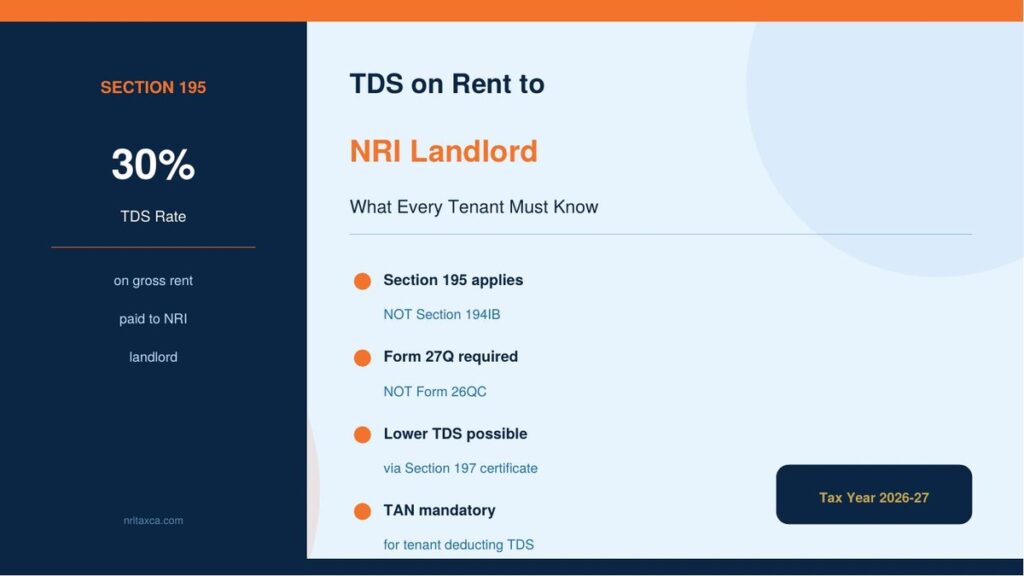
    Here’s something many NRIs and their tenants don’t know: when a tenant pays rent to an NRI landlord, the tenant is legally required to deduct TDS at 30% (plus surcharge and cess) on the gross rent before paying. This is under Section 195 of the Income Tax Act.

    Why does this matter? If your tenant doesn’t deduct TDS, both the tenant and you could face penalties. The tenant also cannot claim the rent as a business expense without TDS compliance.

    The TDS rate for NRI rental income is typically 30% + 10% surcharge (if rent exceeds ₹50 lakh) + 4% health and education cess — making effective TDS up to 31.2% or higher on the gross rent.

    Can the TDS Rate Be Reduced?

    Yes — this is where significant planning opportunity exists. If your actual tax liability (after deductions) is lower than the TDS being deducted, you can apply for a Lower TDS Certificate under Section 197 (now filed via Form 128 / erstwhile Form 13). With this certificate, your tenant can deduct TDS at the lower rate specified by the Income Tax Department rather than the full 30%.

    This is especially valuable when you have loan interest deductions, standard deduction, or other allowable expenses that reduce your taxable rental income significantly. Rather than waiting to claim a refund after filing ITR, get the Lower TDS Certificate upfront.

    How Rental Income Is Computed for NRI ITR

    Rental income falls under the head “Income from House Property” in your ITR. Here’s how it’s calculated:

    Step 1: Gross Annual Value (GAV)

    The Gross Annual Value is typically the actual rent received or receivable, whichever is higher. If the property was vacant for some months, only the rent for the let-out period counts.

    Step 2: Deduct Municipal Taxes

    Municipal taxes (property tax) paid to the local authority are deductible from GAV to arrive at Net Annual Value (NAV).

    Step 3: Standard Deduction — 30%

    You get a flat 30% deduction on NAV as “standard deduction” under Section 24(a). This covers repairs, maintenance, and all property expenses. No receipts needed — it’s automatic.

    Step 4: Deduct Home Loan Interest (If Any)

    If you have a home loan on the rented property, the entire interest paid is deductible under Section 24(b) — with no upper limit for let-out property (unlike self-occupied property which has a ₹2 lakh cap). This can dramatically reduce taxable rental income.

    Taxable Income from House Property

    = GAV − Municipal Taxes − 30% Standard Deduction − Home Loan Interest

    This amount is added to your other India income (if any) and taxed at applicable slab rates.

    Worked Example: NRI Rental Income Tax Calculation

    Ananya lives in Dubai. She rents out her Mumbai flat for ₹40,000/month = ₹4,80,000/year.

    • Gross Annual Value (GAV): ₹4,80,000
    • Municipal taxes paid: ₹18,000
    • Net Annual Value (NAV): ₹4,62,000
    • Less 30% Standard Deduction: ₹1,38,600
    • Less Home Loan Interest: ₹1,80,000
    • Taxable House Property Income: ₹1,43,400

    If this is Ananya’s only India income, it falls in the 5% slab. Her tax = ~₹7,170 — far less than the TDS of ₹1,49,760 (31.2% of ₹4,80,000) her tenant deducted. She should definitely file ITR to claim the refund.

    Which ITR Form for NRI Rental Income?

    NRIs with rental income from India must file ITR-2 (if no business income) or ITR-3 (if business income also present). ITR-1 (Sahaj) is not available to NRIs.

    How to File NRI ITR with Rental Income: Step-by-Step

    1. Register on Income Tax e-Filing Portal (incometax.gov.in) with your PAN
    2. Link your PAN with Aadhaar (mandatory — may need OTP on Indian mobile)
    3. Collect TDS certificates: Ask your tenant for Form 16C (TDS certificate for rent) or check Form 26AS/AIS on the portal for auto-populated TDS credits
    4. Select ITR-2 and choose “Non-Resident” as residential status
    5. Fill Schedule HP (House Property) with rental income details, deductions
    6. Claim TDS credit from Form 26AS — this reduces your tax payable
    7. Verify and submit — e-verify using OTP (Indian mobile) or EVC or net banking

    Bank Account for Refund: Use NRO Account

    If you’re due a TDS refund (which is common given 30% TDS vs lower actual tax), you need an Indian NRO bank account linked to your PAN on the tax portal. Refunds are credited to Indian bank accounts only. NRE accounts cannot receive tax refunds directly.

    Reporting Rental Income in Your Country of Residence

    India taxes your rental income at source. Your country of residence may also require you to report this income. However, most countries have DTAA (Double Tax Avoidance Agreements) with India — so you can claim the Indian tax paid as a credit in your foreign tax return, avoiding double taxation.

    For example, if you live in the UK and paid ₹7,170 in India tax, you report the rental income in your UK Self-Assessment return but claim the India tax as a foreign tax credit, so you pay only the difference (if UK rate is higher).

    Penalties for Non-Filing

    NRIs often think that since TDS was deducted, they don’t need to file an ITR. This is incorrect. If your total India income (including rental income) exceeds the basic exemption limit (₹2.5 lakh under old regime or ₹3 lakh under new regime), you are required to file an ITR — even if TDS has been fully deducted.

    Penalties for non-filing include: late filing fee up to ₹5,000, interest on unpaid tax under Sections 234A/234B/234C, and potential scrutiny/notices from the Income Tax Department.

    Multiple Properties: Additional Rules

    If you own more than two properties, only up to two can be considered “self-occupied” (if not rented). All others are deemed to have a rental income even if vacant — this is called Annual Letting Value (ALV). For NRIs who own multiple Indian properties but live abroad, all properties are typically treated as let-out and annual value must be computed for each.

    Let NRI Tax CA Handle Your Rental Income ITR

    Filing ITR with rental income involves multiple schedules, TDS credit matching, and sometimes claiming refunds. We’ve helped hundreds of NRIs across USA, UAE, UK, Canada, and Singapore file accurate ITRs and claim maximum refunds.

    Our NRI ITR filing service starts at ₹3,499, with rental income included. We handle the full process — from collecting your TDS certificates to filing and e-verification support.

    Estimate your NRI rental income tax and TDS refund with our free NRI tax calculator. Our CA team at Bilash Paul & Associates can file your ITR-2 with rental income — enquire now.

    📞 WhatsApp us at +91 89309 63079 or use our contact form. Tell us your property rental amount and we’ll handle the rest.
  • NRI Rental Income Tax India 2026 — TDS, ITR & DTAA Guide

    ✅ Updated for Income Tax Act 2025. Effective April 1, 2026 — Form 15CA replaced by Form 145, Form 15CB replaced by Form 146.

    NRI Rental Income Tax India 2026 — TDS, ITR & DTAA Guide

    If you are an NRI with a property in India earning rental income, you are liable to pay Indian income tax on that rent — regardless of which country you live in. The tenant deducts TDS, the income must be declared in your ITR-2, and DTAA may reduce your total tax burden. Done correctly, this is straightforward. Done incorrectly, it results in excess TDS, missed refunds, and compliance notices.

    This guide covers everything an NRI landlord needs to know: TDS rates, how to lower them, ITR-2 filing, DTAA treatment of rental income, and how to repatriate rent abroad.

    Is Rental Income from India Taxable for NRIs?

    Yes. Under the Income Tax Act, income earned from property situated in India is taxable in India regardless of the owner’s residential status. If you are an NRI and your Indian property earns rent, that rent is Indian-sourced income and is subject to Indian income tax.

    The tax is computed as follows:

    • Gross Annual Value (actual rent received or receivable)
    • Minus: Municipal taxes paid by owner
    • Equals: Net Annual Value (NAV)
    • Minus: Standard deduction of 30% of NAV (automatic — no bills needed)
    • Minus: Interest on home loan (if applicable — no limit for let-out property)
    • Equals: Taxable rental income

    TDS on Rent Paid to NRI — What the Tenant Must Do

    When a resident Indian pays rent to an NRI landlord, they are legally required to deduct TDS under Section 195 of the Income Tax Act. This applies regardless of the rent amount — there is no threshold exemption for payments to NRIs.

    TDS RateApplicable When
    30% + surcharge + cess = 31.2%Standard TDS rate under Section 195
    As per DTAA rateIf NRI provides TRC + Form 10F before deduction
    As per certificateIf NRI obtains Lower TDS Certificate (Form 13)

    The standard TDS rate of 31.2% on rent is one of the highest applicable rates for NRI income. Most NRI landlords can legitimately reduce this through DTAA or a lower deduction certificate.

    Tenant’s TDS Compliance Checklist

    • Deduct TDS on rent payment each month at 31.2% (or applicable DTAA rate)
    • Deposit TDS with the government by the 7th of the following month
    • File Form 27Q (TDS return for NRI payments) quarterly
    • Issue Form 16A to the NRI landlord within 15 days of filing 27Q

    If the tenant does not deduct TDS, they become personally liable for the tax amount plus interest and penalty. This is a common source of disputes between NRI landlords and resident tenants.

    How to Reduce TDS on NRI Rental Income

    Option 1 — DTAA Benefit

    Most DTAA treaties treat rental income (income from immovable property) as taxable in the country where the property is situated — which means India. The DTAA generally does not reduce the Indian tax rate on rental income, but it does eliminate double taxation by requiring your country of residence to give you credit for Indian taxes paid.

    However, TDS at source can still be reduced if the NRI provides the tenant with a Tax Residency Certificate (TRC) and Form 10F. While the DTAA treaty rate on rent may match the domestic rate in some cases, the formal submission signals to the tenant that the NRI is a legitimate tax resident of a treaty country and can support a Lower TDS application.

    Option 2 — Lower TDS Certificate (Form 13)

    The most effective way to reduce TDS on rental income is to apply for a Lower or Nil TDS Certificate under Section 197. This is filed as Form 13 on the Income Tax portal by the NRI (or their CA).

    The certificate specifies the exact TDS rate the tenant must apply — based on the NRI’s actual tax liability after deductions, exemptions, and DTAA credits. For a property with significant home loan interest, the actual taxable income after all deductions may be much lower than the gross rent, resulting in an effective tax rate far below 31.2%.

    • Application must be filed well in advance — processing takes 4–8 weeks
    • Certificate is valid for the financial year specified
    • Once issued, share with tenant — tenant deducts at the certified rate
    • Renew every financial year

    DTAA Treatment of Rental Income — By Country

    CountryDTAA Treatment of Indian Rental IncomeDouble Tax Eliminated?
    🇦🇪 UAETaxable only in India (UAE has no personal income tax)Yes — no UAE tax liability
    🇺🇸 USAIndia has primary right to tax; USA gives Foreign Tax CreditYes — credit mechanism prevents double tax
    🇬🇧 UKIndia has primary right to tax; UK gives credit for Indian taxYes — credit mechanism prevents double tax
    🇦🇺 AustraliaIndia has primary right to tax; Australia gives foreign tax offsetYes — offset mechanism prevents double tax
    🇨🇦 CanadaIndia has primary right to tax; Canada gives Foreign Tax CreditYes — credit mechanism prevents double tax
    🇸🇬 SingaporeIndia has primary right to tax; Singapore exempts or creditsYes — treaty provides relief

    Unlike NRO interest where DTAA reduces the rate at source, rental income is typically taxable in India at full Indian rates under most treaties. The key benefit is that you are not taxed twice — your country of residence gives you credit for the Indian tax you pay.

    How to File ITR-2 for NRI Rental Income

    NRIs must use ITR-2 to declare Indian rental income. ITR-1 is not available for NRIs. The ITR-2 for FY 2025-26 must be filed by July 31, 2026.

    Documents Required

    • Form 16A from tenant (shows TDS deducted and deposited)
    • Rent agreement and rent receipts
    • Municipal tax receipts (if paid by you)
    • Home loan interest certificate (if applicable)
    • Tax Residency Certificate (for DTAA claim)
    • Form 10F (if claiming DTAA benefit)
    • PAN card and Aadhaar (linked)

    Key Schedules in ITR-2

    • Schedule HP — House Property income computation (gross rent, standard deduction, home loan interest)
    • Schedule TR — DTAA relief claimed (tax paid in India credited against foreign tax liability)
    • Schedule FA — Foreign assets disclosure (required if you hold foreign assets as well)
    • Schedule AL — Assets and liabilities (if total income exceeds ₹50 lakh)

    Repatriating NRI Rental Income Abroad

    Once rent is credited to your NRO account, you can repatriate up to USD 1 million per financial year under the RBI’s Liberalised Remittance Scheme (LRS) for NRIs. The process requires a CA certificate under the Income Tax Act 2025.

    Repatriation Process Under the New Forms (From April 2026)

    • Form 145 (replaced Form 15CA) — Filed by the remitter (you) on the Income Tax portal. Declares the nature of remittance, amount, applicable DTAA provision, and TDS compliance.
    • Form 146 (replaced Form 15CB) — Certificate issued by a CA after examining the transaction. Certifies that applicable taxes have been paid or provided for, that the DTAA provision cited is correct, and that the remittance is compliant.

    Form 146 requires your CA to analyse whether the rental income has been correctly assessed, whether TDS was deducted at the right rate, whether any DTAA relief has been properly applied, and whether the ITR for the relevant year has been filed. This cannot be automated — it requires professional judgment on the specific facts of your case.

    Tax Computation Example — NRI in Australia with Rental Property

    ItemAmount
    Annual rent received₹6,00,000
    Municipal taxes paid₹18,000
    Net Annual Value₹5,82,000
    Standard deduction (30%)₹1,74,600
    Home loan interest₹2,40,000
    Taxable rental income₹1,67,400
    Tax at 30% slab₹50,220
    TDS deducted by tenant (31.2% of ₹6L)₹1,87,200
    TDS refund due₹1,36,980

    This example shows why filing ITR-2 is critical even when TDS has already been deducted — in many cases, the actual tax liability after deductions is significantly lower than the TDS already paid, resulting in a substantial refund.

    Common Mistakes NRI Landlords Make

    • Not informing the tenant to deduct TDS — If TDS is not deducted, the tenant becomes a defaulter. More importantly, you cannot claim the TDS credit that was never deducted. Ensure the tenant is compliant from day one.
    • Not filing ITR-2 annually — Even if TDS covers all tax liability, ITR-2 must be filed to claim refunds, formally record DTAA claims, and avoid notices from the Income Tax Department.
    • Not claiming home loan interest deduction — For a let-out property, there is no cap on the home loan interest deduction. NRIs with home loans on rental properties often leave a significant deduction unclaimed.
    • Not applying for Lower TDS Certificate — The standard 31.2% TDS locks up significant cash for 12–18 months until refund. A Form 13 application costs a small CA fee and recovers lakhs upfront.
    • Assuming rent cannot be repatriated without a CA — Repatriation requires Form 145 + Form 146. Attempting to transfer without these documents is a compliance breach. Budget for this as part of your annual cost of holding Indian property.
    • Not disclosing rental income in the home country’s tax return — Most countries tax their residents on worldwide income. While DTAA prevents double tax via credit mechanisms, you are still required to disclose Indian rental income in your Australian, UK, US, or Canadian return. Failure to disclose is a separate compliance issue in your country of residence.

    Frequently Asked Questions

    My tenant is not deducting TDS. What do I do?

    Your tenant is legally obligated to deduct TDS under Section 195. Remind them in writing. If they continue not to deduct, they face interest (1% per month) and penalty. As the landlord, you can still file ITR-2 declaring the gross rent and pay the tax yourself — but you cannot claim a TDS credit that was never deposited. It is in your interest to ensure the tenant complies.

    I have multiple rental properties in India. Does each need separate compliance?

    Each property is reported separately in Schedule HP of your ITR-2. TDS is deducted separately by each tenant. However, the DTAA claim, Form 10F, and Lower TDS Certificate apply to you as the NRI taxpayer — not per property. One CA can handle all properties in a single ITR-2 filing.

    Can I claim deductions on a property that is vacant?

    A vacant property can be treated as “deemed let out” under Section 23, where the annual value is estimated based on comparable market rents. Alternatively, if you can establish it was genuinely not let out, you may claim it as self-occupied — in which case no rental income is taxed but home loan interest deduction is also capped at ₹2 lakh. A CA should advise on the optimal treatment based on your specific circumstances.

    My property is managed by a property management company. Who deducts TDS?

    If the property management company collects rent and remits it to you, they are the payer and are responsible for TDS deduction under Section 195 if they know you are an NRI. If the company collects rent on your behalf and the final tenant is the payer, it depends on the arrangement. This should be clarified in your property management agreement — an incorrect TDS deduction setup creates compliance risk for both parties.

    How do I repatriate my rental income to my bank account abroad?

    Rental income received in your NRO account can be repatriated up to USD 1 million per year. The process: your CA prepares Form 146 after reviewing your ITR and TDS compliance. You then file Form 145 on the Income Tax portal. Both documents are submitted to your bank, which processes the international transfer. Do not attempt repatriation without these documents — banks are required to verify compliance before remitting.

    Is the Standard Deduction of 30% available to NRIs?

    Yes. The 30% standard deduction on Net Annual Value is available to all property owners, including NRIs. It is automatic — no bills, no proof of repairs or maintenance is required. It covers all repairs, maintenance, and property management expenses as a flat deduction.

    How We Handle NRI Rental Income at NRI Tax CA

    Our rental income service for NRIs covers the complete compliance cycle — not just ITR filing. We advise on Lower TDS Certificate applications, ensure DTAA is correctly applied, file ITR-2 with all deductions claimed, and prepare Form 145 and Form 146 for repatriation. Our fee is fixed. There are no hidden charges based on refund amount or property value.

    ServicePrice
    NRI ITR-2 — Rental income (single property)Starting ₹3,999
    NRI ITR-2 — Multiple properties + DTAAStarting ₹5,999
    Lower TDS Certificate (Form 13) applicationStarting ₹2,999
    Form 145 + 146 for rental income repatriationStarting ₹5,999

    Have rental income in India and unsure if your compliance is correct?
    Email hello@nritaxca.com — we’ll review your situation at no charge and tell you exactly what’s needed.

    Calculate your NRI rental income tax and TDS liability with our free NRI tax calculator. Need help filing ITR or Form 15CA/15CB? Talk to our CA team at Bilash Paul & Associates.

    Updated April 2026. Reflects Income Tax Act 2025 — Form 145 (replaces Form 15CA) and Form 146 (replaces Form 15CB) effective April 1, 2026.

nritaxca.com is the NRI services division of Bilash Paul & Associates, Chartered Accountants, Hisar. Established 1984. View 100+ Google reviews
NRI Tax CA
Replies within 2 hours
👋 Hi! Need CA help with NRI tax — Form 145/146, property TDS, ITR or foreign tax credit?

Fixed quote in 2 hours, all handled over WhatsApp & email.
💬 Start WhatsApp Chat