📅 ITR Filing Deadline: July 31, 2026 — 75 days remaining for FY 2025-26  |  Secure your CA slot →
📅 ITR Filing Deadline: July 31, 2026 for FY 2025-26. Secure your CA slot → hello@nritaxca.com

Tag: NRI India

  • How to File ITR as NRI with Rental Income from India: Complete 2025-26 Guide

    Do you own a house or flat in India that you’ve rented out while living abroad? As an NRI, rental income from Indian property is fully taxable in India — and the tenant is legally required to deduct TDS before paying you rent. Understanding how to handle this correctly can save you significant money and keep you compliant with Indian tax law.

    At NRI Tax CA, we handle NRI rental income ITR filings every year. This comprehensive guide covers everything you need to know.

    Is NRI Rental Income Taxable in India?

    Yes, absolutely. Rental income from property situated in India is always taxable in India, regardless of your residential status. This applies whether you are NRI, RNOR, or full Resident. The property’s location — not your location — determines taxability.

    TDS on NRI Rental Income: The Tenant’s Obligation

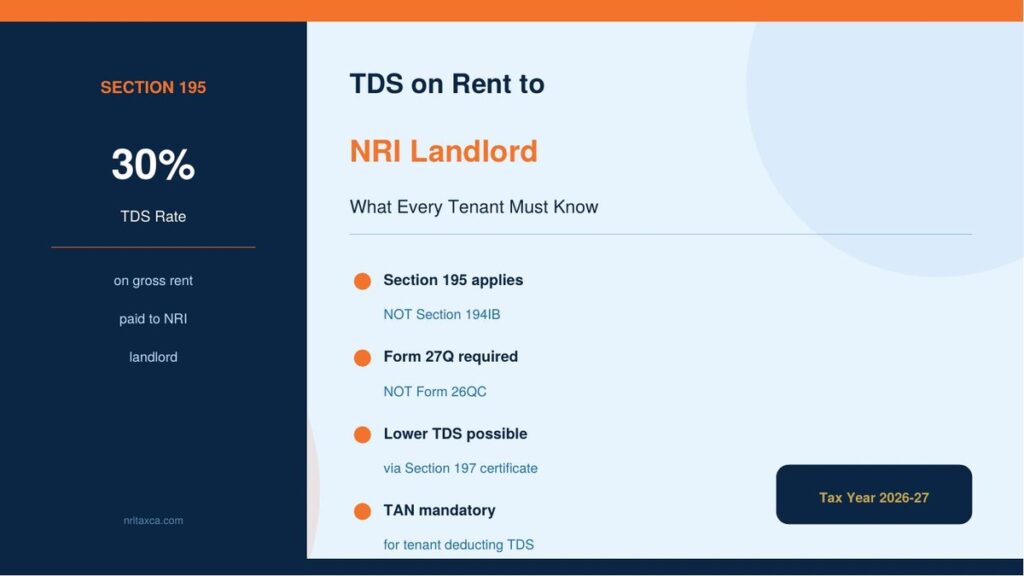
    Here’s something many NRIs and their tenants don’t know: when a tenant pays rent to an NRI landlord, the tenant is legally required to deduct TDS at 30% (plus surcharge and cess) on the gross rent before paying. This is under Section 195 of the Income Tax Act.

    Why does this matter? If your tenant doesn’t deduct TDS, both the tenant and you could face penalties. The tenant also cannot claim the rent as a business expense without TDS compliance.

    The TDS rate for NRI rental income is typically 30% + 10% surcharge (if rent exceeds ₹50 lakh) + 4% health and education cess — making effective TDS up to 31.2% or higher on the gross rent.

    Can the TDS Rate Be Reduced?

    Yes — this is where significant planning opportunity exists. If your actual tax liability (after deductions) is lower than the TDS being deducted, you can apply for a Lower TDS Certificate under Section 197 (now filed via Form 128 / erstwhile Form 13). With this certificate, your tenant can deduct TDS at the lower rate specified by the Income Tax Department rather than the full 30%.

    This is especially valuable when you have loan interest deductions, standard deduction, or other allowable expenses that reduce your taxable rental income significantly. Rather than waiting to claim a refund after filing ITR, get the Lower TDS Certificate upfront.

    How Rental Income Is Computed for NRI ITR

    Rental income falls under the head “Income from House Property” in your ITR. Here’s how it’s calculated:

    Step 1: Gross Annual Value (GAV)

    The Gross Annual Value is typically the actual rent received or receivable, whichever is higher. If the property was vacant for some months, only the rent for the let-out period counts.

    Step 2: Deduct Municipal Taxes

    Municipal taxes (property tax) paid to the local authority are deductible from GAV to arrive at Net Annual Value (NAV).

    Step 3: Standard Deduction — 30%

    You get a flat 30% deduction on NAV as “standard deduction” under Section 24(a). This covers repairs, maintenance, and all property expenses. No receipts needed — it’s automatic.

    Step 4: Deduct Home Loan Interest (If Any)

    If you have a home loan on the rented property, the entire interest paid is deductible under Section 24(b) — with no upper limit for let-out property (unlike self-occupied property which has a ₹2 lakh cap). This can dramatically reduce taxable rental income.

    Taxable Income from House Property

    = GAV − Municipal Taxes − 30% Standard Deduction − Home Loan Interest

    This amount is added to your other India income (if any) and taxed at applicable slab rates.

    Worked Example: NRI Rental Income Tax Calculation

    Ananya lives in Dubai. She rents out her Mumbai flat for ₹40,000/month = ₹4,80,000/year.

    • Gross Annual Value (GAV): ₹4,80,000
    • Municipal taxes paid: ₹18,000
    • Net Annual Value (NAV): ₹4,62,000
    • Less 30% Standard Deduction: ₹1,38,600
    • Less Home Loan Interest: ₹1,80,000
    • Taxable House Property Income: ₹1,43,400

    If this is Ananya’s only India income, it falls in the 5% slab. Her tax = ~₹7,170 — far less than the TDS of ₹1,49,760 (31.2% of ₹4,80,000) her tenant deducted. She should definitely file ITR to claim the refund.

    Which ITR Form for NRI Rental Income?

    NRIs with rental income from India must file ITR-2 (if no business income) or ITR-3 (if business income also present). ITR-1 (Sahaj) is not available to NRIs.

    How to File NRI ITR with Rental Income: Step-by-Step

    1. Register on Income Tax e-Filing Portal (incometax.gov.in) with your PAN
    2. Link your PAN with Aadhaar (mandatory — may need OTP on Indian mobile)
    3. Collect TDS certificates: Ask your tenant for Form 16C (TDS certificate for rent) or check Form 26AS/AIS on the portal for auto-populated TDS credits
    4. Select ITR-2 and choose “Non-Resident” as residential status
    5. Fill Schedule HP (House Property) with rental income details, deductions
    6. Claim TDS credit from Form 26AS — this reduces your tax payable
    7. Verify and submit — e-verify using OTP (Indian mobile) or EVC or net banking

    Bank Account for Refund: Use NRO Account

    If you’re due a TDS refund (which is common given 30% TDS vs lower actual tax), you need an Indian NRO bank account linked to your PAN on the tax portal. Refunds are credited to Indian bank accounts only. NRE accounts cannot receive tax refunds directly.

    Reporting Rental Income in Your Country of Residence

    India taxes your rental income at source. Your country of residence may also require you to report this income. However, most countries have DTAA (Double Tax Avoidance Agreements) with India — so you can claim the Indian tax paid as a credit in your foreign tax return, avoiding double taxation.

    For example, if you live in the UK and paid ₹7,170 in India tax, you report the rental income in your UK Self-Assessment return but claim the India tax as a foreign tax credit, so you pay only the difference (if UK rate is higher).

    Penalties for Non-Filing

    NRIs often think that since TDS was deducted, they don’t need to file an ITR. This is incorrect. If your total India income (including rental income) exceeds the basic exemption limit (₹2.5 lakh under old regime or ₹3 lakh under new regime), you are required to file an ITR — even if TDS has been fully deducted.

    Penalties for non-filing include: late filing fee up to ₹5,000, interest on unpaid tax under Sections 234A/234B/234C, and potential scrutiny/notices from the Income Tax Department.

    Multiple Properties: Additional Rules

    If you own more than two properties, only up to two can be considered “self-occupied” (if not rented). All others are deemed to have a rental income even if vacant — this is called Annual Letting Value (ALV). For NRIs who own multiple Indian properties but live abroad, all properties are typically treated as let-out and annual value must be computed for each.

    Let NRI Tax CA Handle Your Rental Income ITR

    Filing ITR with rental income involves multiple schedules, TDS credit matching, and sometimes claiming refunds. We’ve helped hundreds of NRIs across USA, UAE, UK, Canada, and Singapore file accurate ITRs and claim maximum refunds.

    Our NRI ITR filing service starts at ₹3,499, with rental income included. We handle the full process — from collecting your TDS certificates to filing and e-verification support.

    Estimate your NRI rental income tax and TDS refund with our free NRI tax calculator. Our CA team at Bilash Paul & Associates can file your ITR-2 with rental income — enquire now.

    📞 WhatsApp us at +91 89309 63079 or use our contact form. Tell us your property rental amount and we’ll handle the rest.

  • RNOR Tax Benefits: How Returning NRIs Save Tax for Up to 3 Years After Coming Back to India

    RNOR Tax Benefits: How Returning NRIs Save Tax for Up to 3 Years After Coming Back to India

    Returning to India after years abroad? You may qualify for a special tax status called RNOR — Resident but Not Ordinarily Resident — that shields your foreign income from Indian tax for up to 3 years after your return. This is one of the most valuable and underutilised tax benefits available to returning NRIs.

    At NRI Tax CA, we help returning NRIs claim every benefit they’re entitled to. Here’s everything you need to know about RNOR status.

    What Is RNOR Status?

    RNOR stands for Resident but Not Ordinarily Resident. It is an intermediate residential status between NRI and full Resident (ROR — Resident and Ordinarily Resident). A person can be resident in India (satisfying Section 6(1) conditions) yet qualify as RNOR if they meet additional criteria under Section 6(6).

    Who Qualifies as RNOR? — Section 6(6) Conditions

    Under Section 6(6), a resident individual is classified as RNOR if they satisfy either of these conditions:

    1. They have been NRI in 9 out of the 10 financial years immediately preceding the relevant financial year, OR
    2. They have been in India for 729 days or fewer in the 7 financial years immediately preceding the relevant financial year.

    In simple terms: if you’ve lived abroad for most of the last 10 years, you almost certainly qualify as RNOR for the first 1–3 years after your return to India.

    RNOR Tax Benefits: What’s Not Taxable in India

    The biggest benefit of RNOR status is exemption from tax on foreign-sourced income. An RNOR is taxed in India only on:

    • Income earned or received in India
    • Income from a business or profession controlled from India

    NOT taxable in India for RNOR:

    • Foreign salary (even if received in India’s NRE account, if earned abroad)
    • Foreign business profits not controlled from India
    • Foreign capital gains (e.g., profits from selling overseas property or stocks)
    • Interest on NRE accounts (tax-free as long as RNOR status continues)
    • Interest on FCNR deposits (completely tax-free for NRI and RNOR)
    • Foreign pension income

    This is a massive advantage for returning NRIs who may have substantial investment portfolios, real estate, or business interests abroad.

    How Long Does RNOR Status Last?

    RNOR status is available for a maximum of 3 years after returning to India, though it could be shorter depending on your exact day count and NRI history. After 3 years of Indian residency (in most cases), you will transition to full Resident status (ROR) and your global income becomes taxable in India.

    This 3-year window is the ideal time to:

    • Restructure your foreign investments
    • Realise capital gains on foreign assets at a lower effective tax rate
    • Convert NRE fixed deposits to regular FDs before interest becomes taxable
    • Wind down foreign businesses or transfer management to local managers abroad

    NRE Account: What Happens When RNOR Becomes ROR?

    NRE accounts cannot be maintained once you become a full Resident (ROR). However, during RNOR status, interest on NRE accounts remains tax-free. Once you become ROR, the NRE account must be converted to a resident account and interest becomes taxable.

    Planning this conversion carefully — timing it with your RNOR-to-ROR transition — can save significant tax.

    RNOR vs NRI vs ROR: Quick Comparison Table

    StatusIndia Income Taxable?Foreign Income Taxable?NRE Interest Taxable?
    NRIYesNoNo
    RNORYesOnly if controlled from IndiaNo
    ROR (Full Resident)YesYes (Global Income)Yes

    Practical Example: Returning NRI — 3-Year RNOR Window

    Scenario: Deepa lived in the UK for 12 years and returned to India in October 2024. In FY 2024-25 she was in India for 180 days — she is NRI for that year. In FY 2025-26, she’s in India all year — she becomes Resident. But since she was NRI for more than 9 of the past 10 years, she qualifies as RNOR.

    Her UK rental income and UK pension are not taxable in India in FY 2025-26 due to RNOR status. She files her Indian ITR showing only India-sourced income. This saving could amount to ₹5–15 lakh or more depending on her foreign income level.

    Double Tax Avoidance Agreements (DTAA) and RNOR

    Even if some foreign income becomes taxable in India (e.g., business income controlled from India), India has DTAA agreements with 90+ countries. If you’ve already paid tax abroad on that income, you can claim credit in India to avoid double taxation. This is filed using Form 67 (new Form 44 as per Income Tax Act 2025) — the Foreign Tax Credit form.

    How to Claim RNOR Status in Your ITR

    RNOR status is claimed in your Indian Income Tax Return (ITR) by selecting the correct residential status. Use ITR-2 or ITR-3 depending on your income type. The form asks for your residential status — select “RNOR”.

    You do not need to separately apply for RNOR — it’s determined by the facts (day count + NRI history) and self-declared in your ITR.

    Common Mistakes Returning NRIs Make

    • Filing as full Resident (ROR) when they qualify as RNOR — resulting in unnecessary taxes on foreign income
    • Not maintaining day count records to prove RNOR eligibility
    • Forgetting to convert NRE accounts to resident accounts on time
    • Missing the RNOR window to restructure foreign assets before becoming ROR
    • Not claiming DTAA credit for foreign taxes paid

    Get Expert CA Help for Your RNOR Transition

    The RNOR window is time-limited and planning-intensive. At NRI Tax CA, our CA-assisted service helps returning NRIs correctly declare RNOR status, plan their foreign asset restructuring, and file ITR correctly — so you don’t pay a rupee more tax than you’re legally required to.

    Calculate your tax liability as an RNOR with our free NRI tax calculator India 2026-27. Ready to file ITR or claim RNOR benefits? Get expert CA help from Bilash Paul & Associates, Hisar.

    📞 WhatsApp us at +91 89309 63079 for a confidential consultation. We serve returning NRIs from UK, USA, UAE, Canada, Australia, Singapore, and all other countries.

  • NRI Status in India: How Residential Status is Determined Under Section 6 of the Income Tax Act

    Are you an Indian living abroad and unsure whether you qualify as an NRI for tax purposes? Or perhaps you’ve recently returned to India and don’t know how your tax status will change? Understanding residential status under Section 6 of the Income Tax Act, 1961 is the single most critical factor determining your tax obligations in India.

    At NRI Tax CA, we help NRIs and returning Indians navigate residential status determinations every year. This guide explains exactly how it works — in plain language.

    Why Residential Status Matters for Tax

    Your residential status determines what income India can tax:

    • Resident and Ordinarily Resident (ROR): Global income is taxable in India
    • Resident but Not Ordinarily Resident (RNOR): Only India-sourced income + business/profession income from outside controlled from India is taxable
    • Non-Resident (NRI): Only income earned or received in India is taxable

    Section 6 Explained: The Two Tests

    Section 6 of the Income Tax Act sets out two conditions to determine whether a person is “resident” in India for a given financial year (April 1 to March 31).

    Basic Condition (Section 6(1))

    A person is resident in India if they satisfy either of these conditions:

    1. They are in India for 182 days or more during the financial year, OR
    2. They are in India for 60 days or more during the financial year AND for 365 days or more in the 4 preceding financial years combined.

    Special exception: For Indian citizens who leave India for employment abroad (or as crew of an Indian ship), the 60-day threshold in condition 2 is replaced by 182 days. Similarly, for Indian citizens or Persons of Indian Origin (PIOs) visiting India, the threshold was extended — see the important amendment below.

    2020 Amendment: 120-Day Rule for High-Income NRIs

    The Finance Act 2020 amended Section 6 significantly. For Indian citizens or PIOs visiting India whose India-sourced income exceeds ₹15 lakh in a financial year, the 60-day threshold under condition 2 becomes 120 days (not 182 days).

    This means high-income NRIs who spend 120+ days in India AND have 365+ days in the preceding 4 years will be treated as resident (though potentially RNOR — see below).

    Deemed Resident Rule (Section 6(1A)) — Introduced in 2020

    A new “deemed resident” category was introduced: an Indian citizen who is not taxable in any other country due to domicile, residence, or similar criteria, AND whose India income exceeds ₹15 lakh, will be deemed to be resident in India — even if they spend zero days here.

    This was aimed at stateless individuals or those in zero-tax jurisdictions. If this applies to you, consult a CA immediately — the implications are significant.

    Who Qualifies as NRI?

    You are an NRI (Non-Resident Indian) for income tax purposes if you do NOT satisfy either of the basic conditions under Section 6(1). In practice, this means:

    • You stayed in India for less than 182 days during the financial year (for most NRIs living abroad year-round), OR
    • You stayed less than 60/120 days AND the 4-year look-back test is also not met.

    Note: NRI status under the Income Tax Act is different from NRI status under FEMA (Foreign Exchange Management Act). The IT Act test applies purely for income tax purposes.

    What Income Is Taxable for NRIs in India?

    As an NRI, only the following income is taxable in India:

    • Salary received or earned in India (e.g., for services rendered in India)
    • Rental income from property located in India
    • Capital gains from sale of assets in India (property, stocks, mutual funds)
    • Interest on NRO (Non-Resident Ordinary) accounts
    • Business income from operations in India

    Not taxable in India for NRIs: NRE account interest, FCNR account interest, salary earned and received abroad, foreign capital gains.

    Practical Day-Count: Common Scenarios

    Scenario 1 — Classic NRI: Rahul lives in the USA. He visits India for 45 days in FY 2025-26. He is NRI. Only India income taxable.

    Scenario 2 — Frequent Traveller: Priya visits India for 90 days every year. Over 4 years = 360 days. In FY 2025-26 she visits for 65 days. 65 > 60 AND 360 + 65 = 425 > 365. She becomes RESIDENT. If she just became resident, she may qualify as RNOR (see our RNOR guide).

    Scenario 3 — High Income NRI visiting India: Amit has ₹20 lakh India income and visits for 125 days. Under the 120-day rule, 125 > 120. Combined with 4-year look-back, he may be resident — potentially subject to global income tax. Urgent CA consultation needed.

    How to Count “Days in India”

    Days are counted as calendar days of physical presence in India. Both the day of arrival AND the day of departure are counted as days in India. Flight timings matter — if you land at 11:59 PM, that day still counts.

    Keep a record of all travel: passport stamps, boarding passes, immigration records. The Income Tax Department can verify day counts, and disputes are not uncommon.

    Which Financial Year and Assessment Year?

    Residential status is determined for each financial year separately (April 1 to March 31). The tax return for FY 2025-26 (Assessment Year 2026-27) must be filed by July 31, 2026, and your status for that year is determined by days spent in India between April 1, 2025 and March 31, 2026.

    Documents You Need for Residential Status Determination

    • Passport with all visa stamps and entry/exit records
    • Work visa / employment contract for the country you live in
    • Employer’s letter confirming overseas posting (if applicable)
    • Bank statements showing NRE/NRO accounts
    • Foreign tax returns or proof of tax residency abroad (if any)

    Need Help Determining Your Residential Status?

    An incorrect residential status determination can mean paying tax on global income when you shouldn’t — or missing required tax filings when you should. At NRI Tax CA, we review your day count, passport records, and income profile to give you a clear, CA-certified determination of your status.

    Unsure about your NRI status for the current year? Use our NRI tax calculator — it accounts for residential status automatically. For ITR filing or status determination, consult our CA team.

    📞 WhatsApp us at +91 89309 63079 or fill our contact form for a confidential consultation. We assist NRIs across USA, UAE, UK, Canada, Australia, Singapore, and more.

  • How to Claim Foreign Tax Credit in India — Form 44 (Form 67) Guide for NRIs 2026

    If you are an NRI who has returned to India and is now a resident, or if you are an RNOR earning income both in India and abroad, you may be paying tax in two countries on the same income. The solution is the Foreign Tax Credit (FTC) — a mechanism under India’s Double Tax Avoidance Agreements (DTAA) that allows you to offset taxes paid abroad against your Indian tax liability. Under the Income Tax Act 2025, this is claimed via Form 44 (previously Form 67).

    Who Can Claim Foreign Tax Credit?

    Foreign Tax Credit under Sections 90/91 of the Income Tax Act 2025 is available to:

    • Resident Indians (ROR) who earn foreign income — salary, business income, capital gains, interest — that is also taxable in India
    • RNOR (Resident but Not Ordinarily Resident) individuals in their transition years after returning from abroad
    • Individuals from countries with which India has a DTAA — USA, UK, UAE, Canada, Australia, Singapore, Germany, and 90+ other countries
    • Individuals from countries without DTAA who have paid tax there — FTC is available under Section 91 of the IT Act 2025 as unilateral relief

    What Changed: Form 67 Is Now Form 44

    Under the Income Tax Act 2025 (effective 1 April 2026), Form 67 has been renumbered as Form 44. The underlying process and purpose remain identical — you file a statement of foreign income and foreign taxes paid, and claim the credit against your Indian tax payable. If you search for “Form 67” online, it is the same as Form 44 under the new Act.

    At NRI Tax CA, we handle Form 44 / Form 67 filing as an add-on to ITR filing at ₹1,499 (ITR filing starts at ₹3,499).

    The Critical Deadline You Must Not Miss

    This is the most common and costly mistake: Form 44 must be filed on or before the due date of your ITR. If you file your ITR first and then try to file Form 44 later, your FTC claim will be rejected. The Income Tax Department has been strict about this sequencing, and courts have consistently held that late Form 44 filings do not qualify for the credit.

    For most individuals, the ITR due date is 31 July of the assessment year. For those with audit requirements, it is 31 October. File Form 44 before or on the same day as your ITR — not after.

    What Information You Need to File Form 44

    To file Form 44, you need the following documents from your foreign country of employment or residence:

    • Foreign tax return or assessment order showing the income declared and tax assessed
    • Proof of tax payment — tax paid certificate, withholding tax certificate, or bank statement showing tax deducted
    • Nature of income — salary, capital gains, business income, interest, etc.
    • DTAA Article under which the credit is being claimed
    • Exchange rate on the date of tax payment for conversion to INR

    You do not need to provide foreign documents to us directly — we will tell you exactly what to gather based on your specific country and income type.

    How the Credit Is Calculated

    The FTC you can claim is the lower of: (a) the foreign tax actually paid, or (b) the Indian tax payable on that same income. This prevents a situation where you claim more credit than your Indian tax liability on that income. The calculation is done income-category by income-category — foreign salary credit, foreign capital gains credit, etc. are computed separately.

    For example: If you earned ₹10 lakhs in salary from your US employer and paid ₹2.5 lakhs in US federal tax on it, and your Indian tax on the same ₹10 lakhs is ₹1.8 lakhs — your FTC is limited to ₹1.8 lakhs (the lower amount). The excess US tax paid (₹70,000) is not refundable but may be carried forward under US tax rules.

    Countries Where This Is Most Commonly Used

    Foreign Tax Credit claims are most common for NRIs returning from the United States, United Kingdom, Canada, Australia, Germany, and Singapore. The US in particular has a global taxation system — meaning US citizens and green card holders pay US tax on worldwide income regardless of where they live. When such individuals also become Indian tax residents, Form 44 / Form 67 is essential to avoid double taxation.

    NRI Status and RNOR — The Transition Window

    When you return to India after being an NRI, you typically get a 2–3 year window as an RNOR (Resident but Not Ordinarily Resident). During RNOR status, your foreign income is not taxable in India — only Indian-sourced income is. This makes RNOR status extremely valuable, and careful planning of your return date can determine whether you get this benefit for 2 years or just 1.

    Once RNOR status ends and you become a full Resident (ROR), your global income is taxable in India and FTC via Form 44 becomes essential if you still have foreign income. At NRI Tax CA, our NRI Status & Residential Advisory service (₹4,999) analyses your exact situation and advises on optimal transition timing.

    Get Your Form 44 Filed Correctly

    Foreign Tax Credit calculations involve DTAA interpretation, income-category matching, and precise timing requirements. An error here means either overpaying Indian tax (by not claiming enough credit) or a notice from the Income Tax Department (by claiming incorrectly). At NRI Tax CA, we handle Form 44 as part of your NRI ITR filing — ensuring the credit is maximised legally and filed on time.

    Compute your foreign tax credit and net India tax liability with our free NRI tax calculator. For Form 67 filing and DTAA claim in ITR, consult our NRI tax experts.

    Start your case here — fixed quote within 2 hours, ITR + Form 44 starting at ₹4,998.

  • TDS on NRI Property Sale in India 2026 — Complete Guide for Buyers and Sellers

    When an NRI sells property in India, the tax and TDS rules are significantly different from those applicable to resident Indians. Both the NRI seller and the Indian buyer have specific obligations under the Income Tax Act 2025. Getting these wrong can result in massive over-deduction of TDS, blocked funds, or penalties on the buyer. This guide explains everything clearly.

    Who Must Deduct TDS — The Buyer’s Obligation

    When a resident Indian buys property from an NRI, the buyer is legally required to deduct TDS at source under Section 195 of the Income Tax Act. This is not optional. The buyer must deduct TDS before making payment to the NRI seller and deposit it to the government. Failure to do so makes the buyer a defaulter — attracting interest, penalty, and even prosecution.

    The standard TDS rate on NRI property sale is 20% on long-term capital gains (property held over 2 years) and 30% on short-term capital gains. Crucially, these rates apply on the full sale consideration, not just the profit — unless the NRI obtains a Lower TDS Certificate.

    The Lower TDS Certificate — Form 128 (Erstwhile Form 13)

    The biggest financial mistake NRI sellers make is not applying for a Lower TDS Certificate (now Form 128 under the Income Tax Act 2025, previously Form 13 under the old Act). Without this certificate, the buyer deducts 20–22% TDS on the entire sale value — say ₹1 crore on a ₹5 crore property — even if the actual taxable gain after exemptions is only ₹30 lakhs.

    With a Lower TDS Certificate, the Income Tax Officer determines the exact taxable gain after accounting for indexed cost of acquisition, improvement costs, and exemptions under Section 54/54EC. TDS is then deducted only on the actual taxable amount — potentially reducing TDS from ₹1 crore to ₹6 lakhs in the above example.

    At NRI Tax CA, we handle Form 128 applications starting at ₹7,999. The process involves computing capital gains, preparing the application, liaising with the Income Tax Officer, and obtaining the certificate — typically within 2–4 weeks of filing.

    Form 144 — TDS Return Filing by the Buyer (Erstwhile Form 27Q)

    After deducting TDS, the buyer must file a quarterly TDS return in Form 144 (renamed from Form 27Q under the Income Tax Act 2025). This return reports the TDS deducted on payments to non-residents. The buyer must also issue a TDS certificate (Form 16A) to the NRI seller, which the seller uses to claim TDS credit when filing their ITR.

    Due dates for Form 144 filing are quarterly — 31 July, 31 October, 31 January, and 31 May. Late filing attracts a penalty of ₹200 per day. At NRI Tax CA, we handle complete Form 144 filing for buyers at ₹3,999 per transaction.

    Capital Gains Tax Computation for NRI Sellers

    NRI sellers are taxed on capital gains from Indian property under the same rules as residents, but with additional DTAA considerations. Key points:

    • Long-term capital gains (property held 24+ months): Taxed at 12.5% without indexation from FY 2024-25 onwards, or 20% with indexation for properties acquired before 23 July 2024 (taxpayer’s choice).
    • Short-term capital gains (held less than 24 months): Taxed at applicable income tax slab rates.
    • DTAA benefit: NRIs residing in countries with DTAA (USA, UK, UAE, Canada, Australia, etc.) may be entitled to preferential tax treatment or credit for taxes paid in the country of residence.
    • Section 54 exemption: Long-term capital gains reinvested in another residential property within specified timelines are exempt.
    • Section 54EC exemption: Gains up to ₹50 lakhs invested in NHAI/REC bonds within 6 months are exempt.

    Repatriation After Property Sale

    After the sale and TDS payment, the NRI seller can repatriate the net proceeds abroad subject to RBI guidelines. Repatriation from NRO account is permitted up to USD 1 million per financial year for NRIs, after payment of applicable taxes. You will need Form 145 and Form 146 (erstwhile 15CA/15CB) for the bank to process the overseas transfer.

    Step-by-Step Timeline for NRI Property Sale

    1. Pre-sale: NRI seller applies for Lower TDS Certificate (Form 128) — takes 2–4 weeks.
    2. At sale: Buyer deducts reduced TDS as per certificate. Sale deed registered.
    3. Within 30 days: Buyer deposits TDS to government via challan.
    4. Within the quarter: Buyer files Form 144 (erstwhile 27Q) and issues Form 16A to seller.
    5. ITR filing: NRI seller files ITR, claims TDS credit, and claims applicable exemptions.
    6. Repatriation: With tax clearance and Form 145/146, seller repatriates funds.

    Get Expert Help

    NRI property transactions involve multiple interdependent compliance steps. A mistake by the buyer or seller can result in penalties, blocked accounts, or excess tax deduction that takes years to refund. At NRI Tax CA, we handle the entire chain — Form 128 application, Form 144 filing, ITR, and repatriation documentation — so your transaction is fully protected.

    Compute TDS on your NRI property sale accurately with our free NRI tax calculator. For Form 15CA/15CB filing and Lower TDS Certificate application, get CA assistance here.

    Submit your case here and receive a complete fixed-fee quote within 2 hours.

  • NRI Selling Property in India — Complete Tax Guide 2026

    📅 Planning to sell Indian property? ITR deadline is July 31, 2026. Get CA help now →

    NRI Selling Property in India — Complete Tax Guide 2026

    Selling property in India as an NRI involves two tax systems, mandatory TDS on the entire sale value, strict FEMA repatriation rules, and a bank that won’t process your transfer without CA-certified documents. This guide covers the complete process for FY 2025-26.

    The Biggest Problem — TDS on Full Sale Value, Not Just the Gain

    Under Section 195, the buyer deducts TDS on the entire sale consideration — not just the profit. On a ₹1 crore property with actual gain of ₹35 lakh, TDS deducted is ₹12.5 lakh+ while actual tax is ₹4.4 lakh. The ₹8+ lakh difference sits with the Income Tax Department for 12-18 months.

    Gain TypeHolding PeriodTDS Rate
    Long TermMore than 24 months12.5% + surcharge + cess
    Short Term24 months or less30% + surcharge + cess

    The Solution — Lower TDS Certificate (Section 197)

    Apply via Form 13 on the Income Tax portal at least 8-10 weeks before the sale. The Assessing Officer then specifies a TDS rate matching your actual liability. This is the single most important step for any NRI property sale above ₹50 lakh.

    Capital Gains Exemptions Available to NRIs

    SectionHow to ClaimDeadline
    Section 54Reinvest capital gains in new residential property2 yrs (buy) / 3 yrs (construct)
    Section 54ECInvest up to ₹50L in NHAI/REC bonds6 months from sale date
    Section 54FSelling non-residential asset, reinvest full consideration2 yrs (buy) / 3 yrs (construct)

    Warning: Section 54EC’s 6-month window runs from sale date, not refund date. Invest in bonds first, file ITR later.

    Repatriation — Form 145 and Form 146 (Replaces 15CA/15CB)

    From April 1, 2026, Form 15CA is replaced by Form 145 and Form 15CB by Form 146. Submit these to your bank to transfer sale proceeds abroad. Repatriation limit: USD 1 million per financial year.

    5 Most Expensive Mistakes

    1. Not applying Form 13 in time — ₹8-15 lakh stuck for 18 months.
    2. Missing 54EC 6-month bond deadline — full tax applies.
    3. Not filing ITR — TDS refund permanently lost.
    4. Using old Form 15CA/15CB after April 2026 — bank rejects transfer.
    5. No improvement cost receipts — legitimate deductions lost.

    Our Fees

    ServicePrice
    ITR-2 with capital gains + Section 54/54ECStarting ₹4,999
    Form 145 + 146 for repatriationStarting ₹3,999
    Complete property sale packageStarting ₹6,999

    Planning a sale? Start Form 13 now — waiting costs lakhs.
    Email hello@nritaxca.com — quote in 2 hours.
    Start Your Case →

    Use our NRI property sale tax calculator to compute capital gains, TDS and net repatriation. For Lower TDS Certificate or Form 15CA/15CB filing, contact our NRI tax team.

  • NRI Tax in India 2026 — Complete Guide | Slabs, DTAA & ITR

    If you are a Non-Resident Indian, understanding your tax obligations in India is not optional — it is essential. Many NRIs either overpay tax due to missed deductions, or unknowingly become non-compliant by not filing returns. This complete guide covers everything you need to know about NRI taxation in India for AY 2025-26.

    Who is an NRI for Tax Purposes?

    Your residential status under the Income Tax Act determines what income is taxable in India. An individual is treated as a Non-Resident Indian (NRI) for a financial year if they meet either of these conditions:

    They were outside India for 182 days or more during that financial year, or they were outside India for 365 days or more during the four preceding financial years and stayed in India for less than 60 days in the current year.

    This determination is made fresh every financial year. Your passport, visa status, or country of residence does not automatically make you an NRI — the day count is what matters under Indian tax law.

    There is also a third status called Resident but Not Ordinarily Resident (RNOR), which applies to NRIs who have recently returned to India. RNOR status offers partial tax benefits for up to two years after return and requires careful planning.

    What Income is Taxable in India for NRIs?

    As an NRI, only income that accrues or arises in India, or is received in India, is taxable here. Your foreign income — salary earned abroad, bank interest in foreign accounts, rental income from foreign property — is not taxable in India at all.

    Income that is taxable in India for NRIs includes:

    Salary income — if the services are rendered in India, the salary is taxable in India regardless of where it is paid or received.

    Rental income from Indian property — any property situated in India that generates rent is taxable in India. The fact that you receive the rent in a foreign account makes no difference.

    Interest income from Indian bank accounts — interest earned on NRO accounts is fully taxable in India at applicable rates with TDS deducted at source. Interest on NRE and FCNR accounts is completely exempt from Indian tax.

    Capital gains from Indian assets — profits from selling property, shares, mutual funds, or any other asset situated in India are taxable in India. The rates depend on whether the gain is short-term or long-term.

    Business income from Indian operations — income from a business controlled or set up in India is taxable here.

    TDS Rules for NRIs — Why You Often Overpay

    Tax Deducted at Source works differently for NRIs compared to resident Indians. For most payments to NRIs, TDS is deducted at higher rates — often 30% plus surcharge and cess on gross income, without considering deductions or exemptions.

    This means an NRI receiving rent of ₹10 lakh per year has TDS deducted at approximately ₹31,200 on the full amount, even though their actual tax liability after standard deduction and home loan interest may be zero or much lower.

    The solution is a Lower TDS Certificate under Section 197. By applying on the income tax portal with a projection of your actual tax liability, you can get the TDS rate reduced to match your real obligation. This prevents large amounts from being locked with the Income Tax department for months while you wait for a refund.

    Key TDS rates applicable to NRIs:

    Interest on NRO accounts — 30% plus surcharge and cess. Rental income — 30% plus surcharge and cess under Section 195. Property sale proceeds paid to NRI seller — 20% on long-term gains or 30% on short-term gains, plus surcharge and cess, deducted by the buyer. Dividends — 20% plus surcharge and cess.

    Which ITR Form Should NRIs File?

    NRIs cannot file ITR-1 (Sahaj) under any circumstances. The correct forms are:

    ITR-2 — for NRIs with income from salary, house property, capital gains, or other sources, but no business income. This is the most commonly used form for NRIs.

    ITR-3 — for NRIs who have income from a proprietary business or profession in India in addition to other income.

    ITR-2 requires careful attention to Schedule FA (Foreign Assets disclosure), Schedule FSI (Foreign Source Income), and Schedule TR (Tax Relief). These schedules are frequently missed, leading to defective return notices from the Income Tax department.

    DTAA — How NRIs Avoid Double Taxation

    India has Double Taxation Avoidance Agreements with over 90 countries including the USA, UK, UAE, Australia, Canada, Singapore, and Germany. These treaties ensure that NRIs are not taxed twice on the same income — once in India and again in their country of residence.

    DTAA benefits work in two ways. Under the exemption method, income taxed in one country is exempt in the other. Under the tax credit method, the tax paid in one country is given as a credit against the tax liability in the other country.

    To claim DTAA benefits in India, you need a Tax Residency Certificate (TRC) from your country of residence confirming that you are a tax resident there, and Form 10F filed on the Indian income tax portal. Without these documents, your bank or the Income Tax department will not extend DTAA benefits and full TDS will be deducted.

    DTAA provisions can significantly reduce your tax outgo. For example, under the India-UAE DTAA, UAE residents pay no tax in UAE and can claim relief in India. Under India-USA DTAA, specific rates apply to dividends, interest, and royalties that are lower than domestic rates.

    Capital Gains Tax for NRIs

    Capital gains rules for NRIs largely mirror those for residents, but with important differences in TDS obligations and reinvestment options.

    Property sale — Long-term capital gains (property held over 24 months) are taxed at 12.5% without indexation for sales after July 23, 2024 under the new regime, or 20% with indexation under the old regime for eligible cases. Short-term gains are taxed at slab rates.

    Equity and mutual funds — Long-term capital gains on listed equity shares and equity mutual funds above ₹1.25 lakh are taxed at 12.5%. Short-term gains are taxed at 20%.

    NRIs can claim capital gains exemptions under Sections 54, 54EC, and 54F by reinvesting proceeds into another residential property or specified bonds — subject to conditions and time limits.

    NRO to Foreign Account — How Repatriation Works

    One of the most common pain points for NRIs is moving money from their NRO account to their foreign bank account. The process is governed by FEMA and requires specific documentation.

    NRIs can repatriate up to USD 1 million per financial year from their NRO account. The requirements are that all applicable taxes must have been paid on the funds, and Form 15CA and Form 15CB must be filed before the bank processes the outward remittance.

    Form 15CB is a certificate issued by a practising Chartered Accountant confirming that taxes have been paid on the remittance amount and the applicable DTAA provisions have been considered. Form 15CA is then filed on the income tax portal using the details from Form 15CB.

    Without these forms, your bank cannot legally process the international transfer. Many NRIs are unaware of this requirement and face delays or are forced to use informal channels unnecessarily.

    Key Deadlines for NRIs — AY 2025-26

    ITR filing deadline — 31st July 2025 for AY 2025-26 for NRIs without audit requirement. Belated return — can be filed up to 31st December 2025 with a late fee of ₹1,000 (if income below ₹5 lakh) or ₹5,000. Updated return (ITR-U) — can be filed within 2 years from the end of the relevant assessment year with additional tax payment. Lower TDS certificate application — should be filed well before income is received to avoid full TDS deduction.

    Common Mistakes NRIs Make with Indian Taxes

    Not filing ITR assuming TDS has covered all liability — TDS does not eliminate the filing obligation. Filing ITR-1 instead of ITR-2 — renders the return defective. Not disclosing foreign assets in Schedule FA — attracts penalties under Black Money Act. Missing DTAA benefit claims — results in excess tax payment. Not applying for Lower TDS Certificate — locks refundable amounts with the department for months. Not maintaining Form 26AS — leads to mismatches and notices. Treating NRE interest as taxable — NRE and FCNR interest is fully exempt. Not filing on return to India — RNOR status requires careful handling in the first two years after return.

    How NRI Tax CA Can Help

    We handle complete NRI tax compliance — ITR-2 and ITR-3 filing with DTAA analysis, Schedule FA and Schedule FSI, Form 15CA and 15CB for remittances, Lower TDS Certificate applications under Section 197, and NRI property sale advisory including capital gains computation and reinvestment planning.

    Every case is handled personally by a Fellow Chartered Accountant. Fixed price quoted upfront. 24 to 48 hour turnaround. All communication in writing.

    Email us at hello@nritaxca.com or visit nritaxca.com to submit your case today.

    Get a quick estimate of your NRI tax liability with our free NRI tax calculator India 2026-27. For expert ITR filing, DTAA claims, or TDS compliance, submit an enquiry to our NRI tax team.

    This article is for general information purposes only and does not constitute legal or tax advice. Please consult a qualified Chartered Accountant for advice specific to your situation.

    Use our free NRI Tax Calculator to instantly estimate your property TDS, refund amount and ITR obligation → Calculate Now

  • TDS Refund for NRI on Property Sale in India — How to Claim It (Tax Year 2026-27)

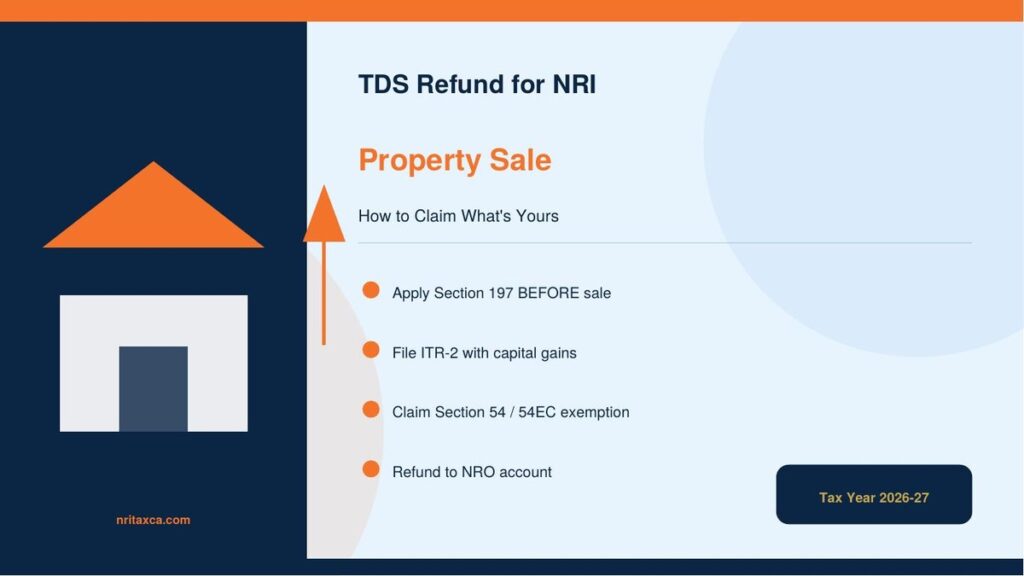
    When an NRI sells property in India, the buyer is legally required to deduct TDS on the sale proceeds. The problem is that TDS is deducted on the entire sale value — not just the actual profit. This means most NRIs end up with far more tax deducted than their actual liability.

    The good news is that this excess TDS is fully refundable. But the process requires correct steps in the right order.


    Why TDS Is Deducted in Excess on NRI Property Sales

    Under Section 195 of the Income Tax Act, when a buyer purchases property from an NRI seller, TDS must be deducted at:

    • 12.5% on the entire sale consideration for long term capital gains (property held more than 2 years)
    • 30% on the entire sale consideration for short term capital gains (property held 2 years or less)

    The critical word is entire sale consideration — not just the gain.

    For example if an NRI sells a property for ₹60 lakh that was purchased for ₹24 lakh, the actual long term capital gain is ₹36 lakh and the tax liability is approximately ₹4.5 lakh. But TDS is deducted at 12.5% on the full ₹60 lakh — which equals ₹7.5 lakh plus surcharge and cess, often totalling ₹8.5 lakh or more.

    The excess of approximately ₹4 lakh is stuck with the Income Tax Department until you claim it back.


    Option 1 — Apply for Lower TDS Certificate Before the Sale

    This is the smartest approach — done before the sale happens.

    Under Section 197 an NRI seller can apply to the Assessing Officer for a Lower or NIL TDS Certificate before the sale is executed. The application is filed in Form 13 on the Income Tax portal.

    The Assessing Officer reviews the actual capital gains calculation and issues a certificate specifying a lower TDS rate matching the real tax liability. The buyer then deducts at this lower rate instead of the standard rate.

    This prevents the cash flow problem entirely — you never lose the excess amount in the first place.

    Important: Apply at least 2 to 3 months before the sale. The process takes time and the certificate must be in hand before the sale agreement is executed.


    Option 2 — Claim Refund Through ITR Filing After the Sale

    If TDS was already deducted at the higher rate without a Lower TDS Certificate, the refund comes through filing your Indian Income Tax Return.

    Step 1 — Verify TDS in Form 26AS Log into the Income Tax portal and check Form 26AS or AIS. The TDS deducted by the buyer should reflect against your PAN. Confirm the amount before proceeding.

    Step 2 — Compute actual capital gains Calculate your actual capital gains correctly — purchase price, improvement costs, indexation if applicable for pre July 2024 purchases, and applicable exemptions.

    Step 3 — Check exemptions available

    Before filing consider whether you qualify for:

    • Section 54 — invest capital gains in another residential property within 2 years of sale or 3 years if constructing
    • Section 54EC — invest capital gains up to ₹50 lakh in NHAI or REC bonds within 6 months of sale
    • Section 54F — for sale of assets other than residential property

    Claiming these exemptions can reduce your actual tax liability to zero — making the entire TDS deducted refundable.

    Step 4 — File ITR-2 File your Indian Income Tax Return in ITR-2 declaring the property sale, capital gains, exemptions claimed, and TDS deducted. The refund amount is automatically calculated.

    Step 5 — Verify the return and await refund After e-filing, verify the return using Aadhaar OTP or net banking. The Income Tax Department processes refunds typically within 3 to 6 months of filing though delays of up to 18 months are common for NRI cases with large refund amounts.


    Can the Refund Go to a Foreign Bank Account?

    Yes — but with conditions. The refund is credited to the bank account linked to your PAN on the Income Tax portal. You can link an NRO account for this purpose. Refunds cannot be credited directly to foreign bank accounts outside India.

    Once the refund reaches your NRO account you can then repatriate it to your foreign account subject to the standard Form 15CA/15CB and USD 1 million per financial year repatriation limits.


    What About Form 15CA and 15CB for Repatriation of Sale Proceeds?

    These are separate from the refund process. Before your bank transfers the property sale proceeds from your NRO account to your foreign account you must submit Form 15CA and a CA-certified Form 15CB. These confirm that applicable taxes have been paid on the remittance.

    The refund amount once credited to your NRO account also requires Form 15CA/15CB for repatriation.


    Timeline — What to Expect

    If you apply for Lower TDS Certificate before sale — TDS deducted matches actual liability. Minimal or no refund needed.

    If claiming refund after sale through ITR — file ITR by 31 July of the Tax Year following the sale. Refund typically processed within 3 to 6 months of filing. For large refunds or cases with scrutiny, expect 12 to 18 months.


    Common Mistakes That Delay Refunds

    • PAN not linked with Aadhaar — refund gets stuck
    • Wrong bank account details on portal — refund rejected
    • ITR not verified within 30 days of filing — return treated as invalid
    • Capital gains not reported correctly — triggers notice instead of refund
    • Section 54/54EC exemption not claimed despite eligibility — excess tax paid

    Need Help Claiming Your TDS Refund?

    Our team handles the complete process for NRI property sale tax compliance — Lower TDS Certificate applications, capital gains computation, ITR-2 filing with exemption claims, and Form 15CA/15CB for repatriation.

    Email us at hello@nritaxca.com or visit nritaxca.com.

    Estimate your TDS refund amount using our free NRI property tax calculator. Ready to file your refund claim? Get expert CA assistance from Bilash Paul & Associates, Hisar.


    Use our free NRI Tax Calculator to instantly estimate your property TDS, refund amount and ITR obligation → Calculate Now

NRI Tax CA
Replies within 2 hours
👋 Hi! Need CA help with NRI tax — Form 145/146, property TDS, ITR or foreign tax credit?

Fixed quote in 2 hours, all handled over WhatsApp & email.
💬 Start WhatsApp Chat